
Reverse mortgage blog
Can You Buy a House With a Reverse Mortgage in Canada? (2026)

General information for Canadian homeowners, not personal financial, legal, or tax advice.
Key takeaways
- You can buy a house with a reverse mortgage in Canada. The mortgage covers part of the purchase price, the rest comes from savings or the sale of your current home, and there are no required monthly mortgage payments afterward (HomeEquity Bank).
- How much the mortgage covers is set by the younger buyer's age, the new home's value, and its location — homeowners typically unlock 20% to 55%, and the market's top tier for borrowers 70 and older reaches up to 60% (how much a reverse mortgage pays by age).
- The home being bought has to be your primary residence — the one you live in. A cottage, a vacation property, or a place you rent out and do not live in cannot carry a reverse mortgage (the full requirements).
- Canadian reverse mortgages start at age 55, and Canada has no government purchase program of any kind. The United States runs a federally insured one that starts at age 62, so the American figures do not carry over (U.S. Department of Housing and Urban Development).
- One Canadian reverse mortgage is portable — a borrower who sells and buys again can carry the mortgage, and its locked rate, to the new home instead of repaying and starting over (the Bloom review).
Yes, you can buy a house with a reverse mortgage in Canada. The mortgage covers part of the purchase price, you bring the rest, and there are no required monthly mortgage payments afterward.
Plenty of Canadians in their sixties and seventies want a different home, not more money out of the one they already own.
The challenge is not usually finding the home. It is paying for it. A retirement income rarely passes a bank’s mortgage test, and paying cash would empty savings that need to last for decades.
A reverse mortgage is normally described as borrowing against a home someone already owns. Buying with one works the other way around. It funds part of a home the buyer does not own yet, and the rest of the price comes from savings or from selling the current home.
This page explains how that purchase works in Canada — how much of the price the mortgage covers, who it suits, what it costs, and why most of what is written on the subject describes American rules.
Can you buy a house with a reverse mortgage in Canada?
Yes. A reverse mortgage can buy a home, not just borrow against one you already own. Nothing is owed monthly afterward, and the mortgage is repaid when the home is eventually sold.
Two rules carry over from every other Canadian reverse mortgage. Every buyer on title has to be 55 or older, and the home being bought has to be your primary residence. The full requirements cover the checklist; how a reverse mortgage works covers the rest of the process.
How does buying with a reverse mortgage actually work?
The lender lends a percentage of the new home’s value. That money goes toward the purchase price, and you bring the difference. The work is in two details.
Your age sets the number, not your income
Three things decide how much you can borrow: the younger buyer’s age, the new home’s value, and where that home is. The percentage climbs with every year of age — homeowners typically unlock 20% to 55% of a home’s value, and the market’s top tier for borrowers 70 and older reaches up to 60% (the year-by-year numbers).
Location counts as much as age. A detached home in a strong urban market reaches the top of the range for its age, while the same age in a weaker market is offered meaningfully less.
Income isn’t tested the way a bank tests it. There’s no stress test (the higher-rate test a bank makes you pass) and no measuring your debts against your income. The lender does check income far enough to be satisfied the property taxes on the new home are comfortably affordable, and most retired buyers meet that easily.
Can you afford the home you want?
Two numbers decide it. The first is what’s left over from selling your current home, once the realtor, the mortgage, and the lawyer are paid. The second is how much a reverse mortgage would lend you on the new home.
The tool below works out both, and puts them beside the price of the house. Enter what you’d sell for, what you’d buy for, and the age of the youngest buyer — every cost is a typical figure you can change to match your own quotes.
Could you buy this home?
Work out what your sale actually leaves you, then see it beside the maximum reverse mortgage on the home you want to buy. Every figure is editable.
The home you are selling
Leave the sale price at 0 if you are not selling a home.
The home you are buying
Closing costs are worked out from the purchase price.
What your sale leaves you
Closing costs on the purchase
Up to 54.8% of the new home’s value at age 72.
This purchase works on these numbers, with $366,700 left over.
You would own the home with no required monthly mortgage payments. Property taxes, home insurance, and upkeep stay yours, the same as with any mortgage.
An estimate, not an approval. The maximum reverse mortgage shown here is an estimate based on age and price. The amount a lender will actually lend depends on the property itself — its type, its location, and its appraised value — and remains at the lender’s discretion until the file is approved. Land transfer tax is Ontario residential, plus Toronto’s municipal tax where selected. Every cost above is a typical figure you can edit to match your own quotes. A free estimate confirms the real number across every Canadian lender.
This is an estimate, not an approval. The reverse mortgage figure comes from age and price; what a lender will actually lend depends on the property, its appraised value, and the lender’s approval — which is what a free estimate confirms across every Canadian lender.
What if you have to sell your old home first?
Most people sell their old home and buy the new one on the same day. The money from the sale comes in, and it goes straight back out to pay for the new house.
Sometimes the days don’t match up. You might have to pay for the new house before the money from your old one arrives.
That’s a common situation, and lenders have ways to cover you for those few days or weeks.
They do need one thing first: a firm sale on your old home. That means a signed agreement with your buyer and any conditions already cleared, so the money is certain to arrive. An offer that could still fall through is not enough.
It’s worth asking about before you make an offer, not after.
And if you still owe money on the home you’re selling, that gets paid off out of the sale. You don’t have to find the money for it.
See what the home you want would actually support
A free, no-obligation estimate prices the purchase across every reverse mortgage lender in Canada, for your age and the home you have in mind — with no impact on your credit.
Get my free estimateHow do you get pre-qualified before making an offer?
In the right order this is straightforward. Making the offer first and sorting out the financing afterward is what causes trouble.
Start with the estimate, before you start looking
A free estimate works out how much a reverse mortgage would lend at your age, on the kind of home you are shopping for, across every lender. No credit bureau is pulled, and there is no application yet.
That number sets your price range: the reverse mortgage, plus whatever you are bringing from savings or from a sale. The tool above works out both halves.
Make the offer conditional on financing
When you find the home, the offer should be conditional on financing. That’s good practice on any purchase, and it does real work here.
The condition buys you a window to have the financing confirmed on that specific property. If the number comes back short, you’re not committed to a purchase you can’t complete.
The appraisal is what turns an estimate into an approval
Once the offer is accepted, the lender orders an appraisal of the home you’re buying — the same step a bank takes on an ordinary mortgage, so nothing about it is unusual.
An estimate is worked out from your age and a price. The appraisal confirms what that particular property is worth, and the percentage is applied to the confirmed value.
The approval comes after that. Then you sit down with your own lawyer for independent legal advice, the lender’s lawyer takes care of the closing, and the home is yours.
Your broker runs the lender side of all of it and stays your point of contact throughout.
Who buys a home with a reverse mortgage?
Five situations account for most of it:
- Buying a better home than your current one sells for. Moving from a $500,000 house into a $1,000,000 one works when the reverse mortgage covers the difference — the new home is what it’s registered against.
- The home you need costs more than the one you’re leaving. A bungalow, or a building with an elevator, often does.
- Moving closer to family or care, without taking on a payment. The move makes sense; a new monthly mortgage payment on a fixed income doesn’t.
- Keeping savings invested instead of putting all of them into the purchase. You only pay interest on the money you’ve actually taken.
- Buying a first home after a lifetime of renting. Savings and a reverse mortgage together can finally end the rent increases.
One more group belongs here: homeowners who already have a reverse mortgage and want to move. On almost every product, selling repays it and the new home needs a fresh application — but Bloom’s SafeRate is the exception, the only portable reverse mortgage in Canada, which an eligible borrower carries to the new home at its locked rate.
Selling and buying smaller is not automatically the cheaper move
Moving to a smaller home is the version most people picture, and it deserves a straight look at the cost.
Selling and buying carries real one-time costs: realtor fees of around 5% plus HST on those fees, land transfer tax on the new home, legal fees at both ends, and the move itself. On a $900,000 sale that runs to tens of thousands of dollars, spent before a dollar of the new home is paid for.
The unknowns are real too — a different street, different neighbours, and routines built over decades left behind.
None of that makes moving the wrong choice. It makes it a math question — and reverse mortgage vs downsizing runs it number by number, every selling cost against every borrowing cost on one Ontario example. Which path leaves a household further ahead, moving or staying put and borrowing against the home they already have, is something a broker prices both ways at no cost — and every way of unlocking that value without moving is walked through in how to release equity from your home in Canada.
Why is most reverse mortgage purchase advice American?
Because Canada has no purchase program of its own, while the United States does — one that’s older, larger, and written about far more.
The American version is a federally insured reverse mortgage. The country’s federal housing agency insures it, borrowers must be at least 62, and the cash a buyer brings to closing is set by government tables (U.S. Department of Housing and Urban Development).
Canada has no equivalent program. Reverse mortgages here start at 55 and come from four Canadian lenders on their own terms.
What protects a Canadian borrower instead is the No Negative Equity Guarantee — you or your estate never owe more than the home’s fair market value at the time the mortgage becomes due, as long as the property taxes, insurance, and upkeep are kept up — plus the independent legal advice every lender requires before closing.
So the figures in American articles describe a product nobody in Canada can buy. The age is wrong by seven years, and the required-cash tables don’t exist here. Planning around them is the most common way a Canadian buyer lands on the wrong number.
What should you watch out for when buying with a reverse mortgage?
There are three, and each one is manageable if it’s settled before an offer is signed.
The home has to qualify, not just the buyer. It must be the home you’ll live in, and a property type lenders accept — detached, semi-detached, townhouse, and condo all do, as the requirements page sets out. A cottage, a property you rent out and don’t live in, or a home on leased land doesn’t.
The one-time costs are the same as on any reverse mortgage. A full appraisal is ordered on almost every application, usually around $350 — though some lenders cover it upfront, which is the kind of thing worth knowing before you pick one. Independent legal advice is billed by your own lawyer, typically $800 to $1,200 in Ontario.
The lender’s set-up fee is built into the mortgage rather than paid out of pocket. These sit on top of the ordinary costs of buying, such as land transfer tax and your closing lawyer’s bill.
Lenders don’t all treat a purchase the same way. Some publish a purchase program openly, others decide it application by application, and the amounts differ on the same home. Which lender will do it, and for how much, is what a comparison settles before an offer goes in — and none of it costs the buyer anything, because the lender pays the broker.
All three are knowable in advance, and settling them takes one conversation rather than an application.
If a reverse mortgage is new to you, the free guide below covers it in full — what you could unlock, what it costs, how the lenders differ, and when it’s the wrong choice:
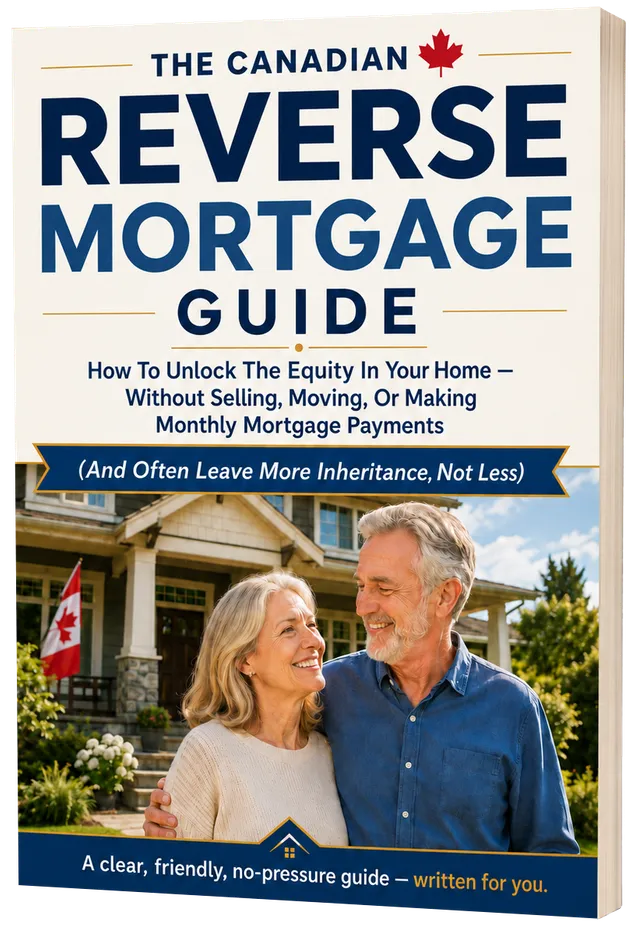
Free Guide:The Canadian Reverse Mortgage Guide
- ✓How much tax-free cash you could unlock — and what moves the number
- ✓The real costs, rates, and fees — nothing buried in fine print
- ✓How the lenders (CHIP, Equitable Bank, Home Trust, Bloom) really compare
- ✓When a reverse mortgage is the wrong choice
Simply enter your info below and a PDF copy will instantly be sent right to your inbox.
Should you buy a home with a reverse mortgage?
The first question isn’t which lender. It’s whether buying with a reverse mortgage is the right move at all.
There are other ways to buy a home after 55. A traditional mortgage works when the income passes the bank’s test and the payments fit the budget comfortably — the borrowing options for homeowners 55 and older sets those side by side. Paying cash works when the savings can genuinely spare it.
And staying put, borrowing against the home you already own, is the option most households never price at all. Whether a reverse mortgage is a good idea works through where it fits and where it doesn’t.
Only after that does the lender question matter. A broker prices those alternatives beside the purchase, compares every reverse mortgage lender in Canada, and handles the file through to closing — best done before the house-hunting starts, not after. How to choose a reverse mortgage broker covers what to ask, and the complete Ontario guide maps the whole market.
Frequently asked questions
Can you use a reverse mortgage to buy a second home or a cottage?
The reverse mortgage goes on the home you live in, so a cottage, a vacation property, or a property you rent out and do not live in cannot carry one. Owning a second home elsewhere does not stop you — the mortgage simply registers against your primary residence, the place you live in for most of the year. The full list of eligible property types is in the reverse mortgage requirements.
Can you move a reverse mortgage to a new home?
Usually no, but there is one exception. On almost every Canadian reverse mortgage, selling the home repays the mortgage, and a new one is applied for on the new home. Bloom's SafeRate is the exception: it is the only portable reverse mortgage in Canada, so an eligible borrower who sells and buys again can carry the mortgage and its locked lifetime rate to the new home rather than repaying and re-applying.
Do you need a down payment to buy a house with a reverse mortgage?
Yes, in effect. A reverse mortgage lends a percentage of the home's value, not the whole purchase price, so the difference has to come from somewhere else — usually the money left from selling a current home, or savings. How large that difference is depends on the younger buyer's age, the new home's value, and its location, because those three things set the percentage a lender will lend.
Can you buy your first home with a reverse mortgage at 55 or older?
Yes. A lifelong renter with savings can use a reverse mortgage to cover part of a purchase price and their savings to cover the rest, then own the home with no required monthly mortgage payments. Property taxes, home insurance, and reasonable upkeep still apply, the same as with any mortgage. The usual rules apply too: every buyer on title must be 55 or older, and the home must be their primary residence.
Is this the same as the American HECM for Purchase program?
No. HECM stands for Home Equity Conversion Mortgage, the United States' federally insured reverse mortgage, and its purchase version has its own government rules — borrowers must be at least 62, and the cash a buyer has to bring to closing is set by federal tables. Canada has no equivalent program. Canadian reverse mortgages start at 55, come from four Canadian lenders on their own terms, and none of the American numbers carry over.
Price the purchase before you make an offer
A free, no-obligation estimate shows how much a reverse mortgage would lend on the home you want, compared across every Canadian lender — with no impact on your credit.
Get my free estimate About the author
Richard Hopkins
Licensed Mortgage Broker · M16000896
Richard has worked in the mortgage business since 2013 — first as a mortgage agent, today a licensed mortgage broker — and leads the reverse mortgage practice at Homestead Financial — Dominion Lending Centres, an FSRA-licensed Ontario brokerage (#11711) with roots in the industry since 1999 and more than 2,500 mortgages funded. More about Richard →
This article is general information for Canadian homeowners, not personal financial, legal, or tax advice. Everyone's situation is different — please get advice on your own numbers before making a decision.