
Reverse mortgage blog
Is a Reverse Mortgage a Good Idea? When Yes, When No (2026)

General information for Canadian homeowners, not personal financial, legal, or tax advice. Rates and lender details verified as of July 26, 2026.
Key takeaways
- A reverse mortgage tends to be a good idea for homeowners 55 and older who plan to stay in the home for years and need the monthly pressure gone — approval is based on age and home value, with no stress test (Financial Consumer Agency of Canada).
- It tends to be a bad idea for a planned sale within a couple of years: one-time set-up costs of about $2,100 to $3,500 plus an early-repayment charge make a short stay expensive (FCAC lists the costs) — though an open product exists for exactly that situation.
- The amounts are larger than most people expect: up to about 46% of the home's value at 55, climbing with age to the market's top tier of up to 60% for borrowers 70 and older (lender product pages).
- The balance grows, but the audited Canadian data is calmer than the fear: the average balance in Canada's only audited pool was 45.2% of home value after years of compounding — on average, borrowers still owned more than half their home (DBRS Morningstar).
- Roughly 60,000 Canadian households have decided yes, together borrowing $10.9 billion — with new borrowing growing more than 16% a year (The Globe and Mail; the household count is an estimate from average balances).
Is a reverse mortgage a good idea? In the right situation, yes — in the wrong one, no. The answer depends on how long you will stay in the home, what the money is for, and your age.
If you have been searching for a straight answer to this question, you have probably noticed something about the answers you find. Lender websites only ever talk about their own product, and a lender page will never tell you that a competitor would suit you better — or that nothing suits you at all. Advice columns often argue against reverse mortgages altogether, and many of them lean on rates and rules from years ago. Neither one begins with the question that actually decides it: what do you need the money to do?
That is where this page begins. It walks through the six things Canadians most often use a reverse mortgage for, and when each one genuinely works. Then it walks through the five situations where the answer is no. It comes from the practice of an Ontario brokerage that also arranges regular mortgages and home equity lines of credit — so when a bank product would serve you better, this page simply says so. If you would like the basics first, what a reverse mortgage is explains the product from the beginning, how a reverse mortgage works covers the process step by step, and reverse mortgage pros and cons in Canada weighs the advantages and disadvantages with the numbers behind each. This page stays with one question: does it fit you?
How do you tell if a reverse mortgage is a good idea?
Three questions settle most of it, and you can answer the first two without any math at all.
How long will you stay in the home? The costs of setting up a reverse mortgage come at the beginning, and the benefits build the longer you stay. So the longer you plan to be in your home, the better the product works for you — and if you expect to sell soon, the answer starts leaning toward no.
What is the money for? The easiest decisions are the ones where you can name the purpose: paying off the mortgage, clearing the credit cards, adding monthly income, paying for home care. Once you can say what the money is for, you can ask the question that really matters — is this the cheapest way to get it?
Is the amount enough? You can access up to about 46% of your home’s value at 55, and the percentage climbs with age, up to the market’s top tier of 60% for borrowers 70 and older. The exact numbers, age by age, are laid out in how much a reverse mortgage pays by age. If the amount available does not cover what you need, the answer changes.
You may have noticed what is not on that list: income and credit. Approval is based on your age and your home’s value. Income and credit are reviewed, but they are not the deciding factors they would be at a bank, and there is no stress test (Financial Consumer Agency of Canada). The complete Ontario guide covers qualifying in full.
When is a reverse mortgage a good idea? The six most common uses
These are the six things Canadians most often use a reverse mortgage for — and what makes each one work.
Paying off the mortgage you still carry
This is the most common use in Canada, and it may be the easiest one to picture. Many retired couples are still sending $1,500 or $2,000 a month to a mortgage, and on a retirement income that payment is often the heaviest line in the budget. A reverse mortgage pays that mortgage off completely and takes its place — that part always happens, it is how the product works. From then on, no monthly mortgage payment is required of you. The interest is added to the new balance instead of coming out of your bank account each month. This works whenever your current balance fits comfortably inside the amount you qualify for, and the estimator further down this page checks that for you in seconds.
Clearing credit cards and other high-interest debts
What makes credit-card debt so hard to escape is the interest rate. Most cards charge around 20%, while a reverse mortgage charges far less — only modestly more than a regular mortgage. That gap matters more than it sounds. On a $45,000 card balance at 20%, the interest alone comes to about $750 every month. So the minimum payments mostly go to interest, and the balance barely moves no matter how faithfully you pay.
A reverse mortgage can clear all of it in one step. On closing day, the money pays off the credit cards, the loans, and even property-tax arrears or collections — directly, before anything comes to you. The minimum payments end that same day. And debts that would make a bank say no, such as tax arrears, are handled the same way: they are simply paid off from the proceeds at closing.
If you are worried this spends your family’s inheritance, it usually does the opposite. The card debt was already draining the estate at 20% interest, faster every month. Moving that debt to a much lower rate slows the loss — and ends the monthly payments at the same time. Debt consolidation for homeowners 55+ walks this use in full: every route, the qualifying ceiling, and when to leave the equity alone.
Adding tax-free monthly income
The money does not have to arrive as one lump sum. If a steady top-up would suit you better, you can receive it as monthly deposits instead. Those deposits are borrowed money — a loan, not income — so they are not taxed, and they do not touch income-tested government benefits. Old Age Security (OAS) and the Guaranteed Income Supplement (GIS) keep arriving exactly as they always have — is a reverse mortgage taxable in Canada covers both benefits in full, including the one situation that can change a supplement payment. This is a common answer when a pension falls short — the situation people call house rich, cash poor, where plenty of value sits in the home but not enough money arrives each month. It happens often after a spouse passes away, because part of the household pension income ends with them. One more comfort worth knowing: you only pay interest on the money you have actually received, never on the full approved amount.
Staying in your home and paying for the upgrades that make it work
Some homeowners know they never want to move. What sometimes stands in the way is the house itself — it needs a walk-in shower, a stairlift or a home elevator, a main-floor laundry, or eventually some paid home care. A reverse mortgage can pay for those changes without touching your savings — what each piece costs, what government programs cover, and every way to fund the rest are walked through in aging in place in Canada. And most people in this situation do not need the full amount on day one. A smaller amount now, with more available later as care needs grow, is usually the better arrangement — borrowing only what you need also protects you at every rate reset later, which reverse mortgage renewals explains.
The renovation itself — paying in stages as the work happens, and what to do if the home needs repair first — is covered in using a reverse mortgage for home renovations.
Helping a child with a down payment
Some parents would rather give part of the inheritance now, while it can change a life, than decades from now. If that is you, the money is tax-free in your hands, the gift itself is not taxed in Canada, and nothing about your monthly budget changes, because no monthly mortgage payments are required. There is one rule worth holding onto: borrow the gift, not the maximum. A $150,000 draw on a $900,000 home leaves most of the home’s value untouched for your estate. And what happens to the home at the end is a settled, family-friendly process — what happens to a reverse mortgage when you die walks through it.
Leaving investments and registered savings untouched
This is the financial-planning use — the one financial planners bring up most. Selling investments to raise cash has two costs that are easy to miss. You may be forced to sell at a bad time, and selling can trigger capital-gains tax (the tax on the growth of investments held outside registered accounts). Taking extra money out of a Registered Retirement Savings Plan (RRSP) or a Registered Retirement Income Fund (RRIF) has its own cost: every extra dollar counts as taxable income that year, and for some retirees the extra income pushes Old Age Security into clawback — the range where the government starts reducing the benefit.
Money from a reverse mortgage does none of this, because borrowed money is not income. There is no tax on it, your benefits keep arriving in full, and your investments stay where they are, still working for you.
What would your own before-and-after look like?
Enter your age, your home value, and what you owe today — the mortgage, any loans, and any credit balances. The estimator works out the minimum payments those balances cost you every month. Then it shows the monthly picture after a reverse mortgage pays them all off at closing — and whether the numbers cover it.
Your situation today
About your home
Your mortgage
Loans (car, personal)
Credit balances
Payments fill in automatically — change them if yours are different.
Before — required every month
After — required every month
Property taxes, home insurance, and upkeep stay yours — the same as with any mortgage.
Monthly payments freed up
$1,656/month
Borrowing only what the plan needs — not the maximum — keeps your options open later.
Estimates for illustration only. The estimated credit payments use the Bank of Canada prime rate of 4.45% (as of July 29, 2026): home equity line at prime + 0.50% (4.95%), line of credit at prime + 7% (11.45%), and credit cards at prime + 16% (20.45%), all as interest-only minimums — adjust any payment to match your real one. Mortgage and loan payments are the amounts you enter. $3,000 total estimated one-time costs, rolled into the mortgage — brokers can sometimes get lender set-up fees reduced or waived. Your real amount, rate, and costs depend on your age, home, and lender — a free estimate confirms them.
Make the numbers real
A free estimate confirms your amount, your rate, and your costs — and how every reverse mortgage lender in Canada compares for your age and home. No cost, no obligation, no credit check.
Get my free estimateWhen is a reverse mortgage a bad idea?
None of the situations below make a reverse mortgage unsafe. Every Canadian file carries the No Negative Equity Guarantee, every file requires independent legal advice (a private meeting with your own lawyer before anything becomes final), and every lender is government regulated. What these situations do is make the product the wrong tool for what you need — and telling you that plainly is the point of this page.
You plan to sell or move within a couple of years
If you already know the house will be sold soon, a reverse mortgage is usually not worth setting up. The costs of starting one come at the beginning — about $2,100 to $3,500 in one-time set-up costs — and repaying within the first few years adds an early-repayment charge on top. The product is built for staying, and its pricing shows it. If you can carry your bills comfortably until the sale, borrowing now simply adds cost for no benefit.
But if the months before the sale are the very thing you cannot afford, a short stay can still work. There are three routes worth pricing against each other. The first is an open reverse mortgage, which you can repay at any time with no charge — in exchange, its rate and set-up fee run higher. The second is a standard product from the lender whose early-exit charges run mildest. The third is no reverse mortgage at all. Which one wins comes down to simple math on your timeline, and paying off a reverse mortgage early covers what an early exit actually costs and when the charges reach zero.
Your mortgage and debts already take up too much of your home’s value
A reverse mortgage has to pay off everything already owing against your home — in full, on day one. That means there has to be room under the lending limit for it to work at all. If what you owe is already close to the most a reverse mortgage can lend, you do not qualify. Picture a $600,000 home at age 65, which qualifies for up to about $300,000. If the mortgage balance on that home is $380,000, the reverse mortgage cannot pay it off, and the file does not work. The estimator above will show you this the moment the balances go in.
There is one route past the normal ceiling. On its own, a reverse mortgage lends at most 60% of the home’s value at the top tier, for the oldest borrowers. In some situations the total can stretch to about 65%, using a reverse mortgage in first position plus a small private second mortgage for the difference. It helps to be clear about what that second mortgage is. It is not meant to be kept for life the way a reverse mortgage is. It makes sense in particular situations — when there is a clear plan for paying it out, or when the monthly room the reverse mortgage frees up lets you pay the second mortgage down and eventually eliminate it. A broker will tell you whether it makes sense for you, or what the better alternative would be in your situation.
And a no today is not always a no forever. The percentage you qualify for climbs with every birthday, and home values move. A file that does not work at 65 sometimes works at 68.
You qualify at the bank and prefer making payments
Maybe none of the bank’s usual barriers apply to you. Your income is still strong, your credit is clean, and the bank would approve you for a refinance or a home equity line of credit tomorrow. And maybe you genuinely like making payments — plenty of people do, because watching a balance go down feels right after a lifetime of doing exactly that. An independent broker arranges those bank products too, and mortgages for seniors in Canada walks through every option side by side — with every alternative priced one by one in reverse mortgage alternatives in Canada.
If that describes you, the bank’s product is the better tool. It costs less, and the main things a reverse mortgage offers — no required monthly mortgage payments, and approval that does not depend on income — solve problems you do not have. The full comparison, run both ways over ten years, lives in reverse mortgage vs HELOC. The rule is simple: when the bank’s product fits your finances and your comfort, take the bank’s product. A reverse mortgage is for people the bank turns away, and for people who are done with monthly payments.
The money is for something you want, not something you need
Qualifying is based on your age and your home’s value, so plenty of people qualify for money they do not actually need. Sometimes the idea is an expensive car, or a boat, or some other purchase that would simply be nice to have. Here is the plain truth: just because you can does not mean you should. A car or a boat starts losing value the day you buy it, while the borrowed money behind it slowly grows with interest. That trade rarely makes sense against your home.
A reverse mortgage works best when it solves a real problem or funds a real plan — clearing payments, adding income, staying in your home, helping family. If the purpose is simply a want, the decision deserves more thought than the approval takes. An independent broker should be the one to say that to you plainly, and a good one will.
You would rather watch a balance shrink
Some people have run their money the same way for forty years — make the payment, watch the balance fall. A reverse mortgage works the other way around: the balance grows. If you already know that thought would sit in the back of your mind and bother you, then this is not the right product for you, and it does not matter what the numbers say. A financial product that costs you sleep is a bad product for you. Some people simply rest easier with a payment and a shrinking balance, and that is a perfectly good reason to say no.
Is a reverse mortgage a rip-off?
No. A reverse mortgage in Canada is a regulated mortgage from government regulated lenders. Independent legal advice from your own lawyer is required before anything becomes final, and you or your estate will never owe more than the home’s fair market value at the time the mortgage becomes due, as long as the homeowner obligations are met.
The rip-off feeling mostly comes from two places: American stories about a different product under different rules, and the surprise of compound interest when nobody walked through the numbers first. The rate runs about 2 to 2.5 points above a regular mortgage — that is the price of years with no required monthly mortgage payments, not a hidden catch.
What a reverse mortgage can be is the wrong tool — for someone moving within a couple of years, someone with a cheaper option available, or a want rather than a need, as the section above covers. The protection against ending up in the wrong-fit group is simple: an independent broker compares every lender and says plainly when this is not the right move.
When is waiting the bigger mistake?
There is one more situation worth naming, and it is the opposite of the five above: the homeowner for whom the answer is yes, who waits anyway.
Retirement planners point out a hard fact about time. At 65 in good health, you may have 20 to 25 summers left where your body can still do what you want it to — travel, garden, keep up with the grandchildren. By 80, even healthy people slow down. Years spent squeezed by a mortgage payment, or putting off the trip, do not come back later. If you fix the money problem at 68, you get ten more good years with the pressure gone. Fix the same problem at 78, and those years have already been spent.
Waiting carries a second cost, and this one is about the numbers. High-interest debt grows every month, so a debt that a reverse mortgage could clear comfortably today can grow, over a few years, past what your home qualifies for. When that happens, the option is gone — and this is one of the most common ways a workable situation becomes an unworkable one.
None of this is an argument to rush — deciding slowly is a feature of this product, not a flaw. It is an argument to decide on purpose, with your numbers in front of you — a free estimate puts them there — rather than by default, one year at a time.
How do you decide for your own situation?
Take your situation back through the three questions at the top: how long you will stay, what the money is for, and whether the amount is enough. The protections stay the same whatever you decide. You stay on title and keep ownership, and the No Negative Equity Guarantee means you never repay more than the home’s fair market value at the time the mortgage becomes due, as long as the homeowner obligations are met (property taxes, insurance, upkeep, and living in the home). What changes from person to person is the fit — and the three things that set your amount are your age, your home’s value, and its location.
The cash-flow estimator above shows the monthly side of the decision. The other side is the balance over time. Enter a home value, an age, and an amount, and watch the balance and your remaining equity move year by year:
Here's What Happens to Your Equity
Adjust the sliders below to see how your equity can change over time.
Need more than this estimate?In some situations we can structure additional financing to unlock more of your equity — contact us to see if it fits your situation.
(80)
Your 15-Year Forecast
In 15 years, your home is projected to be worth $1,935,282 (at 4.5% growth). Even with the growing loan balance, you would still have$1,288,355in remaining equity!
*Disclaimer: These projections are for illustration purposes only and should not be considered financial advice. Projections assume 4.5% annual appreciation and 6.44% interest rate. Actual results may vary based on market conditions and individual circumstances.
Your 15-Year Forecast
In 15 years, your home is projected to be worth $1,935,282 (at 4.5% growth). Even with the growing loan balance, you would still have$1,288,355in remaining equity!
This calculator is for illustration only. Your real numbers depend on your age, lender, rate, and home value — which is exactly what a free estimate works out for you.
If you would rather work through the decision on paper first, the free guide below walks the whole question — the costs, the lender differences, and when the answer should be no — at your own pace:
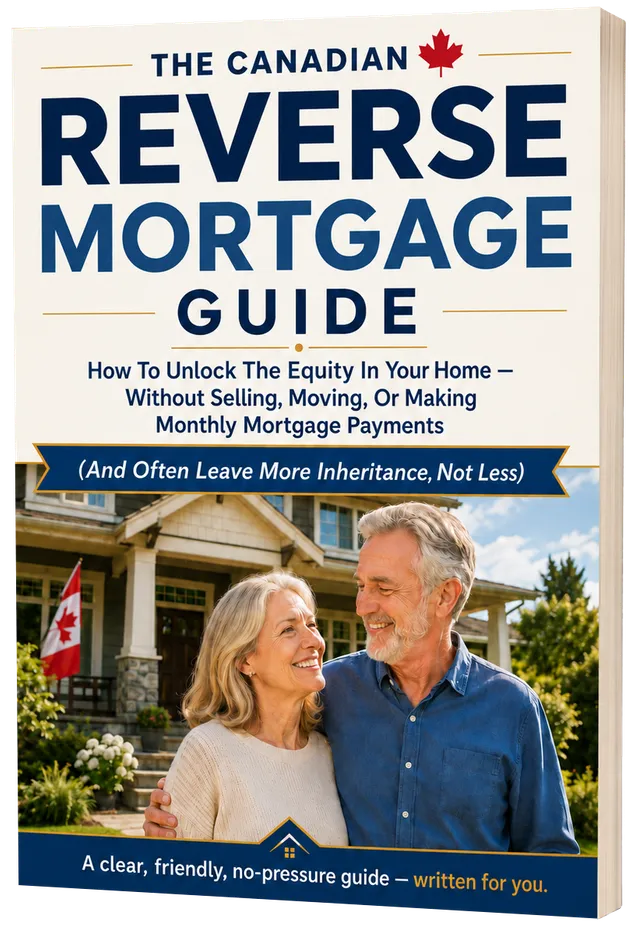
Free Guide:The Canadian Reverse Mortgage Guide
- ✓How much tax-free cash you could unlock — and what moves the number
- ✓The real costs, rates, and fees — nothing buried in fine print
- ✓How the lenders (CHIP, Equitable Bank, Home Trust, Bloom) really compare
- ✓When a reverse mortgage is the wrong choice
Simply enter your info below and a PDF copy will instantly be sent right to your inbox.
How many Canadians decide a reverse mortgage is a good idea?
More every year — and that is worth knowing for one simple reason: it means the uses above are ordinary, not desperate. Roughly 60,000 Canadian households currently have a reverse mortgage, together borrowing $10.9 billion, and new borrowing has grown more than 16% a year over the past decade. The results are calmer than the fears, too. The full market picture, with every number sourced, lives in the reverse mortgage statistics for Canada hub.
Should you get a reverse mortgage? How the personal answer gets made
Everything above describes general patterns. Your situation is specific — an exact age, an exact home, an exact balance to clear, and a timeline only you know. Turning those patterns into your answer is a comparison job, because all four Canadian lenders (HomeEquity Bank, Equitable Bank, Home Trust, and Bloom) price the same homeowner differently — on the amount, the rate, the exit terms, your location, and even which spouse’s age the math uses. The lender ads will not run that comparison for you. Each one stops at its own product.
That comparison is what an independent broker does for you, and it costs you nothing — the lender pays the broker after funding, never you. It usually saves money too, because unpublished rate specials and set-up-fee reductions routinely land below the advertised numbers. And the relationship does not end on the day the mortgage funds. A broker stays your advisor for the life of the mortgage, re-running the numbers when your plans change and reviewing the market before each rate reset, at no cost. When the right answer for you is one of the five no’s above, hearing it early is worth more than any rate discount.
Frequently asked questions
Does a reverse mortgage ever make sense?
Yes, in three situations. When a monthly mortgage payment is the pressure and removing it frees up the budget. When staying in the home for years is the plan. And when the alternatives cost more — selling investments at a bad time, drawing taxable income from registered savings, or carrying credit cards at around 20%. It stops making sense when a sale is coming and nothing is needed in the meantime, when a bank would lend the same money more cheaply, or when what you owe is too near what your age qualifies for. Your age, your home, and your timeline decide it, which is what a free estimate settles.
When is a reverse mortgage a good idea?
When three things line up: you are 55 or older and plan to stay in the home for years, you can name what the money is for (paying off a mortgage, clearing high-interest debt, adding monthly income, funding care or renovations, helping a child), and the amount you qualify for actually covers it. In those situations the product does exactly what it was built for — it removes required monthly mortgage payments and turns home value into tax-free cash.
When is a reverse mortgage a bad idea?
Five situations come up again and again: a planned sale within a couple of years, a mortgage and debts already too large for the amount the home qualifies for, a borrower with strong income who qualifies at a bank and prefers making payments, borrowing simply to fund a want (an expensive car or a boat) rather than a real plan, and anyone who would lose sleep watching a balance grow. None of these make the product unsafe — they make it the wrong tool for that particular situation.
Is a reverse mortgage a good or bad idea for leaving an inheritance?
It depends on what the money replaces. The balance grows over time, but home values usually grow too — in Canada's only audited pool, the average balance was 45.2% of home value even after years of compounding, so borrowers on average still owned more than half their home. Used to clear credit cards at 20% interest, or to avoid selling a home too early, a reverse mortgage can leave a family more to inherit, not less.
Should I get a reverse mortgage to pay off my existing mortgage?
This is the single most common reason Canadians get one. Any existing mortgage or home equity line of credit is always paid off and closed from the proceeds — the reverse mortgage takes its place — and the required monthly payment disappears with it. Whether it is the right move for you comes down to the size of your current balance, your age, and your plans for the home, which is exactly what a free estimate works out.
At what age is a reverse mortgage a good idea?
You can qualify from age 55, and every owner on title generally has to be at least 55. Age alone does not decide whether it is a good idea, but it does set the amount: up to about 46% of the home's value at 55, climbing steadily to the market's top tier of up to 60% for borrowers 70 and older. The fit questions — what the money is for, and how long you plan to stay — matter at every age.
Why do some advisors call a reverse mortgage a last resort?
That caution mostly dates from the years when Canada had a single lender and noticeably higher rates, and it usually compares the product against alternatives without pricing those alternatives. Downsizing costs roughly 5% in real estate commission plus tax, closing costs, and moving costs. Credit cards charge around 20%. Withdrawing extra money from a Registered Retirement Savings Plan is taxed as income. A reverse mortgage is neither a first resort nor a last one — it is one tool to price against the others on your own numbers.
Get the answer for your own situation
A free, no-obligation estimate shows what you qualify for, what it costs, and how every reverse mortgage lender in Canada compares for your age and home. No income documents, no credit check.
Get my free estimate About the author
Richard Hopkins
Licensed Mortgage Broker · M16000896
Richard has worked in the mortgage business since 2013 — first as a mortgage agent, today a licensed mortgage broker — and leads the reverse mortgage practice at Homestead Financial — Dominion Lending Centres, an FSRA-licensed Ontario brokerage (#11711) with roots in the industry since 1999 and more than 2,500 mortgages funded. More about Richard →
This article is general information for Canadian homeowners, not personal financial, legal, or tax advice. Everyone's situation is different — please get advice on your own numbers before making a decision. Rates and lender details verified as of July 26, 2026.