
Reverse mortgage blog
What Is a Reverse Mortgage in Canada? (2026 Guide)

General information for Canadian homeowners, not personal financial, legal, or tax advice.
Key takeaways
- A reverse mortgage is a loan for homeowners 55 and older that turns part of a home's value into tax-free cash, with no required monthly mortgage payments (Financial Consumer Agency of Canada).
- The money is a loan, not income — it is not taxed, and it does not affect Old Age Security or the Guaranteed Income Supplement (FCAC).
- Canadian homeowners typically unlock 20% to 55% of the home's value (FCAC), and the market's top tier for borrowers 70 and older reaches up to 60%.
- You stay on title and keep ownership of your home (FCAC), and every Canadian lender includes the No Negative Equity Guarantee — you never repay more than the home's fair market value at the time the mortgage becomes due, as long as homeowner obligations are met.
- Reverse mortgages have existed in Canada since 1986 — today roughly 60,000 households hold one (an estimate from average balances), together borrowing more than $10.9 billion (The Globe and Mail).
- Canada had one reverse mortgage lender until 2018 and has four today — all government regulated (Home Trust press release).
A reverse mortgage is a loan for homeowners 55 and older that turns part of a home’s value into tax-free cash, with no required monthly mortgage payments — repaid when you sell, move out, or pass away.
Most people hear the words “reverse mortgage” long before anyone explains them properly. A neighbour mentions one. A television ad promises cash for the retirement you deserve. An American headline warns about seniors losing their homes. This page is the plain-English starting point: what a reverse mortgage actually is in Canada, who it is for, what it is not, and where the common fears come from. No pressure and no sales pitch — just the definition, explained the way a first-time reader deserves.
What is a reverse mortgage?
A reverse mortgage is a loan secured against your home that pays you, instead of the other way around. With a regular mortgage, money moves in one direction: you pay the bank every month, and the balance slowly falls. A reverse mortgage turns that around. The lender can pay you (steady, tax-free monthly deposits, if that is what you want) while the balance slowly grows — and that is the “reverse” in the name. The deposits are borrowed money, a loan and not income, which is why they arrive tax-free. In practice, most homeowners take one lump sum instead, use it to pay off their existing mortgage and other debts, and simply live without those monthly bills.
Instead of being paid monthly, the interest is simply added to the mortgage balance. The loan is repaid later, in one step, when you sell the home, move out permanently, or when the last borrower passes away (Financial Consumer Agency of Canada). The full walk-through — the steps from application to funding, how the interest adds up, and how repayment happens — lives in how a reverse mortgage works in Canada.
A shorter definition, if one sentence is all you need: a reverse mortgage is a mortgage with no required monthly mortgage payments — it replaces any mortgage you still have, can clear high-interest debts, and pays whatever is left to you as tax-free cash, all without selling your home. Canada’s federal consumer agency notes that financial institutions sometimes call this “equity release” — the British name for the same idea.
One thing the name does not make obvious: this is still just a mortgage. It is registered against your home’s title the same way any mortgage is, by a lawyer, and discharged the same way when it is repaid. Nothing about the “reverse” part changes who owns the home — the home stays yours.
Is a reverse mortgage a loan or income?
It is a loan. Because the money is borrowed rather than earned, it is not income — it is not taxed, no tax slip arrives in February, and it does not need to be reported as earnings.
The part that matters most to many retirees: because it is not income, it does not affect income-tested government benefits. Old Age Security (OAS) and the Guaranteed Income Supplement (GIS) arrive exactly as they always have (FCAC). Compare that with pulling extra money out of a Registered Retirement Savings Plan (RRSP), which counts as taxable income and, for some people, can push Old Age Security into clawback territory.
How is a reverse mortgage different from a regular mortgage or a HELOC?
The clearest way to see the definition is next to the mortgage you already know:
| Regular mortgage | Reverse mortgage | |
|---|---|---|
| Monthly mortgage payments | Required, every month | None required — interest joins the balance instead |
| Approval based on | Income, credit, and the stress test | Mostly age and home value |
| Balance over time | Shrinks as you pay | Grows as interest is added |
| How it is repaid | A little with every monthly payment, over many years | All at once — when you sell, move out permanently, or pass away |
| Who owns the home | You | You |
A HELOC (a home equity line of credit) is the product most often compared with a reverse mortgage. It also lets you borrow against the home, usually at a lower rate — but it is built for a different borrower. A bank approves a HELOC on income, clean credit, and the stress test, which are exactly the tests that get harder after retirement. It requires monthly payments, and the bank can reduce or freeze the line. A reverse mortgage asks for none of that month to month, which is why it exists for the 55-and-older homeowner in the first place. One practical rule: an existing mortgage or HELOC cannot stay in place — it is always paid off and closed from the proceeds when the reverse mortgage is set up. (One lender does allow a small private second mortgage behind a reverse mortgage, up to about 65% of the home’s value in total. It can help reach a larger amount, but it is not a structure to keep indefinitely — it calls for a solid plan, and a broker runs that analysis case by case.)
That is the definitional difference. Whether the reverse mortgage or the line of credit is the better tool for a given household is a real question with real math behind it, and the reverse mortgage vs HELOC comparison runs it properly, ten years out, both ways.
Who is a reverse mortgage for in Canada?
The Canadian rules are clear about who qualifies. You must be a homeowner aged 55 or older — and everyone registered on the home’s title must generally be 55 or older and go on the mortgage together. The home must be your primary residence, meaning you live there at least six months of the year. Detached homes, semis, townhomes, and condos all qualify — the full checklist is set out in the reverse mortgage requirements in Canada.
Approval works differently than at a bank, and this is the part that surprises many readers. The amount is based mostly on your age and your home’s value — not on income paperwork. There is no stress test and no debt-ratio math. Income and credit are looked at, but they are not the big decision-makers the way they are at a bank. That is why retirees who were declined for a refinance or a HELOC (a home equity line of credit) often still qualify comfortably. A low credit score is a much smaller factor here — and money owing, like property taxes in arrears or high-interest debts, can often be paid off right out of the proceeds at closing. How the bank’s income tests actually work after retirement — and where a reverse mortgage sits among every option open to a senior — is laid out in mortgages for seniors in Canada.
Only four lenders offer reverse mortgages in Canada: HomeEquity Bank (the CHIP brand from television), Equitable Bank, Home Trust, and Bloom Finance. All four are government regulated lenders. There is no government program behind these loans — the Canada Mortgage and Housing Corporation, the federal housing agency, plays no role — which is one of several ways the Canadian product differs from the American one. The big banks are not in this market at all: RBC, TD, Scotiabank, BMO, and CIBC do not offer reverse mortgages, and a branch will usually refer you out to one of the four. Worth noticing: no lender shows you the other three’s offers, so comparing the whole market is a job no single lender can do for you — it is what an independent broker is for. How those four compare with each other is its own topic, covered in the best reverse mortgage companies in Canada — and the Ontario picture, where all four compete, is mapped in the complete Ontario reverse mortgage guide.
What are the main features of a reverse mortgage in Canada?
Five features define the Canadian product. Together they are the definition in practice.
No required monthly mortgage payments. This is the feature people come for. Nothing leaves your bank account each month for the mortgage. The ordinary costs of owning a home — property taxes, home insurance, and reasonable upkeep — stay yours, the same as with any mortgage. Optional payments are allowed if you ever want to slow the balance growth, but they are never required.
You keep title and ownership. The home stays yours. The lender registers a mortgage against it, exactly as with a regular mortgage, and has no claim on the ownership itself. You decide if and when to sell — the lender cannot make that decision for you.
The money is tax-free. As covered above: a loan, not income. No tax, no effect on Old Age Security or the Guaranteed Income Supplement.
You choose how to receive it. One lump sum, steady monthly deposits, a mix of the two — and you only pay interest on the money you actually take. Anything approved but untouched costs nothing until you draw it.
The No Negative Equity Guarantee. Every Canadian reverse mortgage lender includes this protection. As long as the homeowner obligations above are met, you or your estate never repay more than the home’s fair market value at the time the mortgage becomes due (when you sell, permanently move out, or pass away). If the balance ever grew past the home’s value, the lender absorbs the difference — not your family.
One more protection applies to every file: before anything becomes final, every lender requires independent legal advice (a private meeting with your own lawyer, not the lender’s, to make sure you fully understand the mortgage). A product designed for people in their 60s, 70s, and 80s is deliberately slow and careful to enter. That is a feature, not a flaw.
How much can you get from a reverse mortgage?
Canadian homeowners typically unlock 20% to 55% of the home’s value (FCAC), and the market’s top tier for borrowers 70 and older reaches as high as 60%. Where you land in that range depends mostly on age — the percentages start conservative at 55 and climb steadily every year after. Your home’s value, its type, its location, and the lender’s own rules fill in the rest.
Two details are worth knowing even at the definition stage. First, for couples, some lenders base the math strictly on the younger spouse’s age, while others use a combined age for the couple — and that one difference can change the offer by tens of thousands of dollars. It is also a clean example of why you should never assume the first quote you see is the best the market can do. Second, if you still owe on a mortgage or a HELOC (a home equity line of credit), it gets paid off from the proceeds at closing. That is not a problem to work around — it is the single most common use, because it is what makes the monthly payment disappear.
The age-by-age percentages — what to realistically expect at 55, at 65, at 75 and beyond — are laid out in how much a reverse mortgage pays by age. Or model your own numbers directly:
Here's What Happens to Your Equity
Adjust the sliders below to see how your equity can change over time.
Need more than this estimate?In some situations we can structure additional financing to unlock more of your equity — contact us to see if it fits your situation.
(80)
Your 15-Year Forecast
In 15 years, your home is projected to be worth $1,935,282 (at 4.5% growth). Even with the growing loan balance, you would still have$1,288,355in remaining equity!
*Disclaimer: These projections are for illustration purposes only and should not be considered financial advice. Projections assume 4.5% annual appreciation and 6.44% interest rate. Actual results may vary based on market conditions and individual circumstances.
Your 15-Year Forecast
In 15 years, your home is projected to be worth $1,935,282 (at 4.5% growth). Even with the growing loan balance, you would still have$1,288,355in remaining equity!
This reverse mortgage calculator is for illustration only. Your real numbers depend on your age, lender, rate, and home value — which is exactly what a free estimate works out for you.
What would your own home qualify for?
A free, no-obligation estimate shows your real number — your age, your home, today's rates — with no impact on your credit.
Get my free estimateWhat are the biggest misconceptions about reverse mortgages?
Many of the common beliefs about reverse mortgages are years out of date, so the definition is not complete without correcting the four that stop people from even reading further.
“The bank owns your home.” This is the most common belief, and it is wrong. You stay on title, you keep full ownership, and the federal consumer agency says it plainly: you still own your home. The lender holds a mortgage — the same legal claim that sits behind every regular mortgage in the country — never the ownership.
“It leaves nothing for the kids.” The balance grows, but the home’s value usually grows too — and the home’s growth applies to the full value of the home, while interest applies only to the amount you borrowed. Canadian borrowers keep about half of their equity on average when the mortgage is repaid, and many keep far more. Used well (to clear 20% credit cards, for example, or to avoid selling a home too early) a reverse mortgage can leave an estate larger, not smaller. What actually happens to the home and the family at the end is walked through in what happens to a reverse mortgage when you die.
“Reverse mortgages are a scam.” The fear is understandable, and the conclusion is wrong. This is one of the most protected loans in the country: four government regulated lenders, a required private meeting with your own lawyer before anything becomes final, and a process that takes weeks by design. The genuinely frightening Canadian stories tend to be title fraud or pressure tactics — problems that exist around any mortgage — and they are examined case by case in reverse mortgage horror stories: what’s real in Canada, with the scam question itself answered head-on in reverse mortgage scams in Canada.
“It’s the product from those American horror stories.” The American product is a different product, under different rules. The classic American story goes like this: a younger spouse is left off the loan, and when the older spouse passes away, the survivor is suddenly asked to repay it. That cannot happen the same way in Canada, because everyone on title must generally be on the mortgage, together, from day one. The American product also runs through a government insurance program, while the Canadian one is a private loan from regulated Canadian lenders with the No Negative Equity Guarantee built in. American headlines simply do not describe Canadian mortgages.
What none of this answers is whether a reverse mortgage is right for a particular household — that is a genuine weighing of trade-offs, and it gets its own full page: the pros and cons of a reverse mortgage in Canada. And when the question is whether it fits your own situation, is a reverse mortgage a good idea walks through when the answer is yes and when it is no. It is also exactly the question an independent broker answers for you — by comparing every reverse mortgage lender in Canada against your age, your home, and your plans — for free. The lender pays the broker, never you.
The questions that usually come next — what it really costs, how the lenders compare, and when a reverse mortgage is the wrong move — are exactly what the free guide below covers.
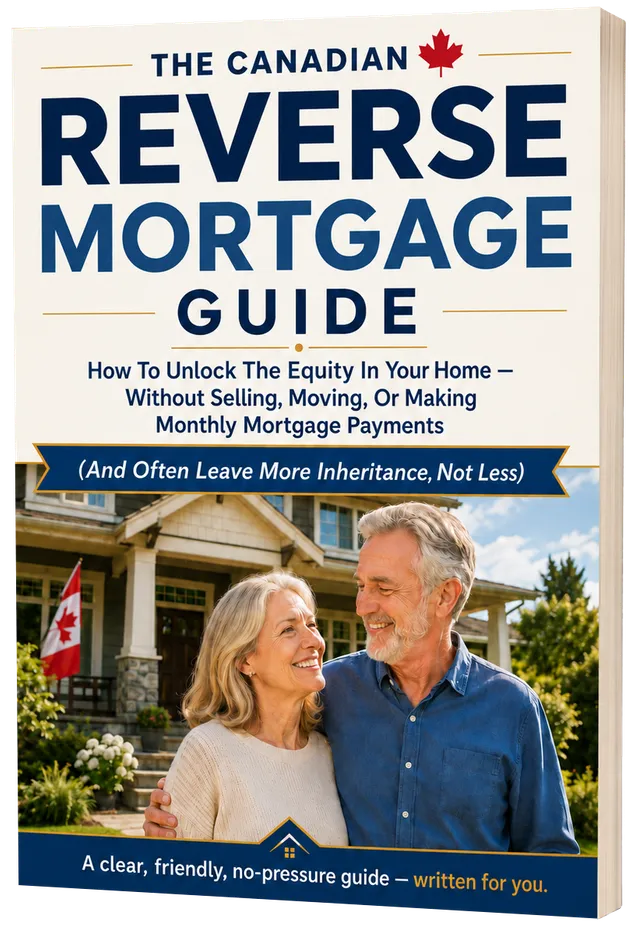
Free Guide:The Canadian Reverse Mortgage Guide
- ✓How much tax-free cash you could unlock — and what moves the number
- ✓The real costs, rates, and fees — nothing buried in fine print
- ✓How the lenders (CHIP, Equitable Bank, Home Trust, Bloom) really compare
- ✓When a reverse mortgage is the wrong choice
Simply enter your info below and a PDF copy will instantly be sent right to your inbox.
Where did reverse mortgages in Canada come from?
The product is older than most people guess. Canada’s first reverse mortgage launched in 1986 under the Canadian Home Income Plan — the program that became CHIP, today’s HomeEquity Bank product. For more than three decades it was the only option in the country. Then competition finally arrived: Equitable Bank entered in 2018, Bloom in 2021, and Home Trust launched EquityAccess in October 2025, bringing the count to four government regulated lenders competing for the same homeowners.
After forty years, the numbers show a product that has moved from fringe to mainstream:
Behind those totals are real households: roughly 60,000 of them hold a reverse mortgage today (an estimate from average balances — the statistics page shows the math), and thousands of Canadians start one every year. Set that against the 2.66 million homeowners 55 and older who could qualify, and the room left to grow is exactly why every lender keeps competing for these files.
The growth has two plain causes: an aging population that owns its homes outright, and real competition among lenders for the first time. All four now cut rates within weeks of each other to win files. Reverse mortgage rates still run modestly higher than regular mortgage rates, because the lender may wait many years to be repaid and that patience is priced in. How those rates are set, and what they mean in dollars, is unpacked in the guide to reverse mortgage rates in Canada — and every other market number above carries its named source on the same statistics page, re-verified quarterly.
Frequently asked questions
What is a reverse mortgage in simple terms?
It is a loan for homeowners 55 and older, secured against the home, that pays you instead of you paying it. There are no required monthly mortgage payments — interest is added to the balance instead — and the loan is repaid when you sell, move out permanently, or pass away. You stay on title and keep ownership the whole time.
Do you have to make monthly payments on a reverse mortgage?
No. There are no required monthly mortgage payments — the interest is added to the mortgage balance instead of being paid each month. The ordinary costs of owning a home stay yours, the same as with any mortgage: property taxes, home insurance, and reasonable upkeep. Optional payments are allowed if you ever want to slow the balance growth, but they are never required.
Does the bank own your home with a reverse mortgage?
No. You stay on title and keep full ownership and control. The lender registers a mortgage against the property, exactly as with a regular mortgage, and removes it when the loan is repaid. At no point does the lender own the home.
Are reverse mortgages a scam in Canada?
No. Canadian reverse mortgages come from four government regulated lenders, and every file includes a required private meeting with your own lawyer before closing. The process is slow and document-heavy by design. The frightening stories in the news are almost always title fraud or pressure tactics — problems that exist around any mortgage — not the product itself.
Is money from a reverse mortgage considered income?
No. It is borrowed money, so it is not income, it is not taxed, and no tax slip is issued. It also does not affect income-tested government benefits — Old Age Security (OAS) and the Guaranteed Income Supplement (GIS) arrive exactly as they always have.
What does 'equity release' mean?
It is another name for the same idea. The term comes from the United Kingdom, where these products are called equity release, and some Canadian institutions use it too. In Canada, the product these names describe, for homeowners 55 and older, is the reverse mortgage.
What is the downside of a reverse mortgage?
The main trade-off is that interest is added to the balance instead of being paid monthly, so the amount owing grows over time. Rates also run modestly higher than a regular mortgage, and repaying in the first few years brings an early-exit charge. Home values usually grow too, which offsets much of the interest — Canadian borrowers keep about half of their equity on average when the mortgage is repaid.
Ready to see your own numbers?
A free, no-obligation estimate shows what your age and home would qualify for across every Canadian lender — with no impact on your credit.
Get my free estimate About the author
Richard Hopkins
Licensed Mortgage Broker · M16000896
Richard has worked in the mortgage business since 2013 — first as a mortgage agent, today a licensed mortgage broker — and leads the reverse mortgage practice at Homestead Financial — Dominion Lending Centres, an FSRA-licensed Ontario brokerage (#11711) with roots in the industry since 1999 and more than 2,500 mortgages funded. More about Richard →
This article is general information for Canadian homeowners, not personal financial, legal, or tax advice. Everyone's situation is different — please get advice on your own numbers before making a decision.