
Reverse mortgage blog
Reverse Mortgage Kingston: Amounts and Lenders (2026)

General information for Canadian homeowners, not personal financial, legal, or tax advice.

Key takeaways
- The typical Kingston home was worth $552,500 in July 2026 — a single-family house $577,000, an apartment $358,000, and prices overall nearly flat from a year earlier (Kingston and Area Real Estate Association).
- How much you can borrow is set by age. On the typical Kingston home — the July 2026 benchmark of $552,500 — that is up to about $279,000 at 65 and up to about $320,000 at 75 (the full age-by-age breakdown).
- All four government regulated reverse mortgage lenders lend on Kingston homes, and none of them needs a local branch — everything is arranged by email, phone and video call (the complete Ontario guide).
- Kingston is a city people retire to, and many arrive as cash buyers. A mortgage-free home is the cleanest reverse mortgage case there is — nothing to pay off at closing, so the whole amount is available (buying a home with a reverse mortgage).
- Kingston's own property-tax help is real but small: a $100 yearly senior credit and a deferral capped at $1,000 a year, each with its own low-income eligibility test (City of Kingston).
- Every reverse mortgage needs independent legal advice — a short visit to your own lawyer's office, costing $800 to $1,200 in Ontario (what happens in that appointment).
A reverse mortgage in Kingston follows the same rules as everywhere in Ontario — what changes is the amount. On July 2026 Kingston values, a homeowner at 65 can access up to about $181,000 on a typical apartment and up to about $291,000 on a single-family house.
Kingston is one of the few Ontario cities people move to for retirement. Some homeowners here have lived in the same house for forty years. Many others sold in Toronto or Ottawa, bought in Kingston, and plan to enjoy every year of it. Both groups tend to want the same thing: to stay in the home they have, without worrying about money every month.
The challenge is that a home’s value does not pay the bills. A Kingston house may be worth $600,000 while the savings shrink and the pension covers only so much.
A reverse mortgage turns part of the home’s value into money without selling. This page sets out current Kingston home values, the amount available at 65, 70 and 75, which lenders lend here, the city’s own property-tax help, and what the required legal appointment looks like.
What are Kingston homes actually worth right now?
The Kingston and Area Real Estate Association tracks prices with a benchmark — its measure of what a typical home of each type is worth. A benchmark is steadier than an average, because one unusual month of sales can’t distort it. Here is Kingston and the area around it in July 2026.
| Kingston area, July 2026 | Benchmark price | Change from a year earlier |
|---|---|---|
| A typical home, all types together | $552,500 | −0.6% |
| Single-family house | $577,000 | −0.9% |
| Townhouse and row homes | $396,600 | −2.9% |
| Apartment | $358,000 | −5.3% |
Benchmark prices from the Kingston and Area Real Estate Association’s July 2026 statistics, published through the Canadian Real Estate Association.
Two things stand out in that table. Kingston prices held nearly flat over the past year — the typical home slipped less than 1%. And a typical single-family house is worth about $219,000 more than a typical apartment, which matters because the amount a reverse mortgage gives you is a percentage of what the home is worth.
There is also plenty on the market. More Kingston homes were listed for sale this July than in any July in a decade — good news for anyone still planning their move here.
How much can you get on a Kingston home at 65, 70, or 75?
The amount is set mainly by the age of the youngest homeowner. The older you are, the more of the home’s value a lender will advance, because the lender expects to wait fewer years to be repaid.
The table below applies the age-by-age percentages to the Kingston benchmark values above.
| Age of the youngest homeowner | Up to this much of the home’s value | Typical apartment $358,000 | Typical Kingston home $552,500 | Typical single-family house $577,000 |
|---|---|---|---|---|
| 65 | about 50.5% | about $181,000 | about $279,000 | about $291,000 |
| 70 | about 53% | about $190,000 | about $293,000 | about $306,000 |
| 75 | about 58% | about $208,000 | about $320,000 | about $335,000 |
Percentages are the ceilings on the market’s highest-lending products, and are the same ones behind the reverse mortgage calculator. Kingston values are the association’s benchmarks for July 2026.
Those are ceilings, not starting points, and you don’t have to take the maximum. You’re charged interest only on the money you actually take, so taking less keeps the balance smaller.
One thing is worth knowing before comparing offers. The advertised rate is the retail price. A broker can often get a lower rate that is never advertised, and set-up fees have room in them too — sometimes they are waived entirely. None of it costs the homeowner anything, because the lender pays the broker.
What would your Kingston home qualify for?
A free, no-obligation estimate works out the real number for your age and your address — compared across every reverse mortgage lender in Canada, with no impact on your credit.
Get my free estimateYour own home is almost certainly not the benchmark. Put its value and the youngest owner’s age in below, and the amount changes with them:
Here's What Happens to Your Equity
Adjust the sliders below to see how your equity can change over time.
Need more than this estimate?In some situations we can structure additional financing to unlock more of your equity — contact us to see if it fits your situation.
(80)
Your 15-Year Forecast
In 15 years, your home is projected to be worth $1,935,282 (at 4.5% growth). Even with the growing loan balance, you would still have$1,288,355in remaining equity!
*Disclaimer: These projections are for illustration purposes only and should not be considered financial advice. Projections assume 4.5% annual appreciation and 6.44% interest rate. Actual results may vary based on market conditions and individual circumstances.
Your 15-Year Forecast
In 15 years, your home is projected to be worth $1,935,282 (at 4.5% growth). Even with the growing loan balance, you would still have$1,288,355in remaining equity!
This calculator is for illustration only. Change the home value and the age to see how the amount changes — then a free estimate confirms the real figure against every lender.
What a lender will lend on a Kingston home
Every lender advances more of a home’s value where homes resell predictably, and less where they don’t. Kingston is an established city market where homes sell all year round, so a home in the city or its built-up surroundings qualifies for close to the highest percentages above.
The countryside is different. While lenders differ on how far out they will go, rural properties are accepted by some lenders, sometimes with lower maximum lending amounts. The appraisal decides it either way.
How does a reverse mortgage work in Kingston?
The product is the same across Canada — there is no Kingston version, and no local rule that changes it.
If you are 55 or older, you borrow against the home you live in. There are no required monthly mortgage payments: the interest is added to the balance instead, and the mortgage is repaid when the last borrower sells, moves out permanently, or passes away. Property taxes, home insurance and reasonable upkeep stay your responsibility, and the home has to remain your primary residence — the requirements in full cover the details.
The money is tax-free. It clears any existing mortgage and debts first, and the rest lands in the bank account to use as you please.
Two protections come with every lender. Independent legal advice is required before anything becomes final. And under the No Negative Equity Guarantee, neither you nor your estate ever repays more than the home’s fair market value at the time the mortgage becomes due, as long as the property taxes, insurance and upkeep are kept up.
The full walkthrough is in how a reverse mortgage works in Canada, and the province-wide picture is in the complete Ontario guide.
Which lenders lend on Kingston homes?
All four of Canada’s reverse mortgage lenders lend on Kingston homes: HomeEquity Bank (the company behind CHIP), Equitable Bank, Home Trust and Bloom. That is the whole market, and all four are government regulated.
None of them needs a branch on Princess Street. Reverse mortgages are arranged remotely everywhere in Ontario — everything is done by email, phone and video call, and the appraiser visits the home.
Comparing all four is what changes the outcome in dollars. Each lender sets its age, property and location limits in a slightly different place, so four answers on the same Kingston house can differ by tens of thousands of dollars.
Two of the four can’t be reached by phoning around: one lends only through mortgage brokers, and another’s highest-lending product is arranged only through mortgage brokers. The four lenders weighed head to head covers how they differ.
Rates work the same way everywhere in the province — no lender prices by city, and the rates guide has the current numbers with the date they were checked.
Why do Kingston reverse mortgages so often start on a paid-off home?
Kingston is a city people retire to. Military careers pass through Canadian Forces Base Kingston and the Royal Military College, and many of those families come back to stay. Plenty of people work at Queen’s University for their whole careers and stay on afterwards. And every year, retirees sell in Toronto or Ottawa, buy in Kingston for much less than the sale money, and keep the difference.
Many of those buyers pay cash — and that changes the reverse mortgage math here.
A home bought with cash is the cleanest case there is
Someone who sold elsewhere and paid cash for their Kingston home has no mortgage to pay off. That is the simplest possible reverse mortgage: nothing has to be paid off first, so the whole amount — up to about 50.5% of the home’s value at 65 — is available for whatever the money is needed for.
There is a quiet second benefit. A home with no mortgage registered on it is the preferred target for title fraud, because its full value is sitting there for a criminal who manages to impersonate the owner.
A reverse mortgage adds a registered charge to the title. Any new borrowing against the home then has to pay that lender out first — real statements, real accounts and real lawyers — which makes that crime much harder to do quietly. Not a reason to get a reverse mortgage on its own — but on a paid-off home, it is added protection you gain.
Buying in Kingston before the old home sells
Plenty of buyers find the right Kingston home before their old one has sold. A reverse mortgage can be part of that purchase from the start — the sale money becomes the down payment, the mortgage covers the rest, and there are no required monthly mortgage payments afterward. Buying a home with a reverse mortgage walks through the purchase step by step, including what happens when the two closing dates don’t line up.
And for many families, the move to Kingston is itself a downsizing decision — selling a bigger, more expensive home somewhere else. Reverse mortgage vs downsizing prices both routes, including the moving costs most people only discover at the end.
Can you defer property taxes in Kingston?
Kingston has its own property-tax help, and it is worth knowing exactly what it covers — it is real, and it is small.
As of August 2026, the City of Kingston offers three programs for eligible homeowners:
- A senior’s tax credit of $100 a year — for owners 65 or older who receive the Guaranteed Income Supplement.
- A tax deferral capped at $1,000 a year — up to half the yearly bill can be postponed, with interest charged on the postponed amount. For owners 65 or older on the Guaranteed Income Supplement, or owners receiving Ontario Disability Support Program benefits.
- A deferral of tax increases — the same eligibility, covering increases caused by reassessment.
A homeowner can use only one program at a time, and applications close at the end of April each year.
One more thing worth knowing: a property-tax deferral and a reverse mortgage don’t combine — it is one route or the other. Keeping the property taxes paid is one of the responsibilities that comes with a reverse mortgage, and if a deferral balance is already owing to the city, it is paid out of the mortgage money when the mortgage is set up.
A $1,000 deferral helps with one bill. What it can’t do is fix a monthly budget that has stopped working — and a tax bill that keeps falling behind is often a sign of that bigger squeeze, not the whole problem. Property tax deferral in Ontario covers every city’s program, what deferral fixes, and what it can’t.
What does the legal appointment look like in Kingston?
Every reverse mortgage in Canada requires independent legal advice: one private meeting with your own lawyer — not the lender’s — who reads the mortgage first, then confirms you understand it and are signing freely.
The split exists on purpose. On a traditional mortgage, one lawyer or closing company usually acts for both the lender and the borrower. On a reverse mortgage the roles are separated: the lender’s lawyer completes the closing, and your own lawyer acts only for you, explaining everything from the legal side.
The Ontario cost is $800 to $1,200, billed by the lawyer directly, and it is usually settled out of the mortgage money at closing rather than paid up front. The appointment itself is a short visit to the lawyer’s office — lenders generally want this meeting held in person. Where getting to an office is genuinely difficult, a video call can sometimes be allowed instead.
A lawyer referral is free if you want one, and if you already have a lawyer you trust, simply use them. Independent legal advice for reverse mortgages covers what happens in that appointment and what to bring.
Questions about the mortgage itself — the rate, the amount, which lender fits, what it costs — are the broker’s job, and those can be asked at any point along the way.
Who does a reverse mortgage fit in Kingston?
A reverse mortgage tends to fit when the goal is staying in the home with less financial stress. Four situations come up most often:
- A mortgage still being paid in retirement. Clearing it removes the monthly mortgage payment, which is the most common reason these are arranged.
- Credit cards or a line of credit that never shrink. Minimum payments mostly cover interest while the balances creep closer to their limits.
- A bank that said no. Approval here is based on age and the home, not on proving a pension can cover a monthly payment.
- Staying put after already moving once. For someone who moved to Kingston to retire, moving again is the last thing wanted — the money is what makes staying possible.
A reverse mortgage fits badly when a sale is already close and nothing is needed before it, or when what is still owing on the mortgage is more than the age-based limit allows. And when there is strong income, good credit and a genuine preference for making monthly payments, a regular mortgage or a HELOC — a home equity line of credit — is usually the cheaper route, and an independent broker arranges those too.
What this looks like on a $575,000 Kingston home
A couple who sold near Toronto at 65 and paid cash for a single-family home here own it outright. Five years on, the roof is due, the car is twelve years old, and the savings are thinner than they planned. At 70 they can borrow up to about 53% of what their home is worth, which is roughly $305,000.
They take $80,000, because you don’t have to take the most a lender will lend. They make no monthly mortgage payments, and they are charged interest only on the money they actually borrow. If they need more in a few years, they can ask for more, up to the amount they were approved for.
Everything is done by email, phone and video call, so every number is in writing for them to read over as many times as they want. Their grown children are copied on the emails if the couple wants them involved, and an in-person meeting can be arranged if you would rather sit down together.
A free estimate works out the same numbers for your own home across all four lenders — no cost, no obligation.
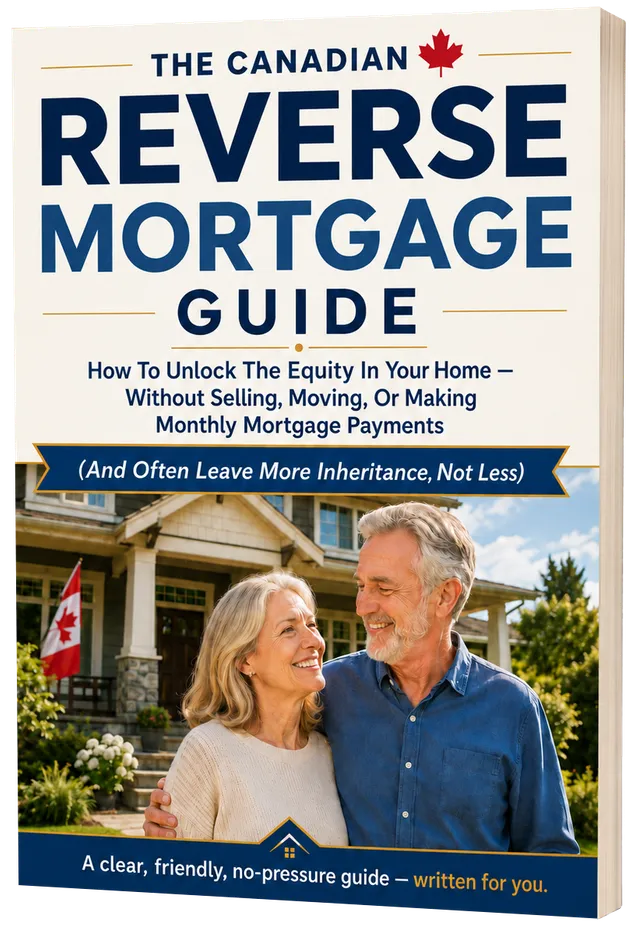
Free Guide:The Canadian Reverse Mortgage Guide
- ✓How much tax-free cash you could unlock — and what moves the number
- ✓The real costs, rates, and fees — nothing buried in fine print
- ✓How the lenders (CHIP, Equitable Bank, Home Trust, Bloom) really compare
- ✓When a reverse mortgage is the wrong choice
Simply enter your info below and a PDF copy will instantly be sent right to your inbox.
The first question is never which lender — it is whether a reverse mortgage is the right fit at all, or whether savings, a regular mortgage or a HELOC would do the job for less. An independent broker prices every route for free, because the lender pays the broker rather than the homeowner. Choosing a reverse mortgage broker sets out the licence check and the questions worth asking before you pick who to work with.
Ready to see what you qualify for?
It takes two minutes: no cost, no obligation, and no impact on your credit — just the real number for your Kingston home, compared across all four lenders.
Get my free estimateFrequently asked questions
Can you get a reverse mortgage in Kingston, Ontario?
Yes. All four of Canada's reverse mortgage lenders lend on Kingston homes. The rules are the same as everywhere in Ontario: the youngest homeowner is 55 or older, and the home is where you actually live. A licence from the Financial Services Regulatory Authority of Ontario covers the whole province, so the mortgage itself is arranged by email, phone and video call. The appraiser visits the home, and the required independent legal advice appointment is a short visit to a lawyer's office.
How much can you get on a Kingston home?
Up to about 50.5% of the home's value at 65, up to about 53% at 70, and up to about 58% at 75, on the market's highest-lending products. On July 2026 Kingston benchmark prices, that is roughly $181,000 to $208,000 on a typical apartment, $279,000 to $320,000 on the typical Kingston home, and $291,000 to $335,000 on a typical single-family house. These are ceilings rather than quotes — age, the property and the location set the real figure, and a free estimate works it out for your own home.
Can you use a reverse mortgage to buy a retirement home in Kingston?
Yes. A reverse mortgage can pay for part of the purchase itself: the down payment comes from selling the old home or from savings, the reverse mortgage covers the rest, and there are no required monthly mortgage payments on the new home. Timing matters when the Kingston purchase closes before the old home sells. Some lenders can cover that gap for a short time, but only when the old home's sale is firm — a signed agreement with any conditions already cleared, so the money is certain to arrive. It is arranged before closing day, not after.
Who offers reverse mortgages in Kingston?
Four lenders offer reverse mortgages in Canada, and all four lend on Kingston homes: HomeEquity Bank (the company behind CHIP), Equitable Bank, Home Trust and Bloom. All four are government regulated. Two of the four cannot be reached by phoning around — one lends only through mortgage brokers, and another's highest-lending product is arranged only through mortgage brokers. That is why comparing all four through one independent broker is the usual starting point.
Does a reverse mortgage work on rural properties outside Kingston?
Often, yes — with a difference. In Kingston itself and the built-up communities around it, every lender lends, and a home there qualifies for close to the highest percentages a lender publishes. Further out in the countryside, rural properties are accepted by some lenders, sometimes with lower maximum lending amounts, because a lender advances less where a home would take longer to resell. The appraisal decides what a particular property qualifies for, and a free estimate shows which lenders fit it before anyone commits to anything.
See the real number for your Kingston home
Get a free, no-obligation estimate and find out exactly how much you could access — compared across every reverse mortgage lender in Canada, with no impact on your credit.
Get my free estimate About the author
Richard Hopkins
Licensed Mortgage Broker · M16000896
Richard has worked in the mortgage business since 2013 — first as a mortgage agent, today a licensed mortgage broker — and leads the reverse mortgage practice at Homestead Financial — Dominion Lending Centres, an FSRA-licensed Ontario brokerage (#11711) with roots in the industry since 1999 and more than 2,500 mortgages funded. More about Richard →
This article is general information for Canadian homeowners, not personal financial, legal, or tax advice. Everyone's situation is different — please get advice on your own numbers before making a decision.