
Reverse mortgage blog
Does CIBC Offer a Reverse Mortgage? (2026)

General information for Canadian homeowners, not personal financial, legal, or tax advice.

Key takeaways
- CIBC does not offer a reverse mortgage. It defines the term in its own online mortgage glossary, alongside conventional and convertible mortgages, but has no such product.
- What CIBC offers a homeowner with equity is the CIBC Home Power Plan — a mortgage and a line of credit combined, approved on CIBC's lending criteria, which means proving income that can carry the payments.
- Four lenders offer reverse mortgages in Canada, and two of them are Schedule 1 Canadian banks — set up under the same federal law as CIBC. Both are named by the Financial Consumer Agency of Canada.
- Banking with CIBC changes nothing. A reverse mortgage is registered against the home by whichever lender funds it, and a CIBC mortgage or line of credit secured on that home is paid off and closed from the money at closing.
- CIBC's glossary puts the amount at up to 50% of the home's value. Across the market the maximum reaches up to 60% of the home's value, and the percentage climbs with age (how much by age).
CIBC does not offer a reverse mortgage. It defines the term in its own mortgage glossary but has no such product — the four lenders that offer reverse mortgages in Canada are HomeEquity Bank, Equitable Bank, Home Trust, and Bloom.
Homeowners who have banked with CIBC for decades usually check there first when they start looking into a reverse mortgage.
The challenge is not that CIBC hides the answer. It is that the bank explains what a reverse mortgage is without ever saying whether it offers one, so the search ends in a definition rather than an answer.
CIBC does define the term, in its online mortgage glossary, alongside conventional and convertible mortgages. Defining a product and offering it are two different things. This page gives the direct answer, explains the CIBC product that comes closest, and covers what happens to a CIBC mortgage or line of credit if a reverse mortgage goes ahead.
Does CIBC offer a reverse mortgage?
No. CIBC has no reverse mortgage product, and there’s no CIBC version of one under another name.
What the bank offers a homeowner who wants to borrow against a house they already own is the CIBC Home Power Plan, a mortgage and a line of credit combined. It’s approved the way bank lending normally is — on income.
Reverse mortgages come from four specialized lenders instead. Two of them are Canadian banks. Which banks offer reverse mortgages in Canada sets out the whole market, bank by bank.
What does CIBC offer instead of a reverse mortgage?
The CIBC Home Power Plan. It puts a regular mortgage and a home equity line of credit together under one plan, both secured against the home.
Why the credit line grows as the mortgage shrinks
The two halves are linked. As the mortgage balance comes down each month, the line of credit is topped back up by the same amount, so the total borrowing room stays where it started.
That design is the opposite of a reverse mortgage. Room opens up on the Home Power Plan because payments are being made every month.
Those payments are the catch for a homeowner in their sixties or seventies. CIBC approves the plan on its own lending criteria, which means showing income that can comfortably carry them.
That’s where a retired homeowner with a paid-off house and a modest pension often runs into trouble. Plenty of equity and a perfect payment history don’t settle it, because banks don’t lend on equity alone.
None of that makes the bank product the wrong answer. An independent broker arranges lines of credit and refinances too, so the real choice is between two products, not between a broker and a bank. How a reverse mortgage and a home equity line of credit differ sets the two side by side.
Why does CIBC define a reverse mortgage if it doesn’t offer one?
Because it’s a real Canadian mortgage product, and a bank that explains mortgage terms to its customers has a reason to cover this one.
CIBC’s online mortgage glossary defines the terms its customers run into, and reverse mortgage sits in it with its own entry and its own page.
The definition is short and fair: a homeowner over 55 can borrow against part of the home’s value, no monthly mortgage payments are required, and interest is added to the balance until the home is sold or the owner passes away. The glossary’s entry for “mortgage” even lists reverse mortgage among the kinds a reader might want to look up next.
That matters for one reason. Anyone who has searched their own bank’s website and found a definition but no product starts to wonder whether they’ve misunderstood something. They haven’t. A reverse mortgage is a normal, regulated Canadian mortgage — explained by one of the country’s largest banks in its own glossary, and offered by four lenders that specialize in it.
The number in that definition is conservative
One line in the glossary is worth correcting, because a homeowner could rule themselves out on it.
CIBC puts the amount at up to 50% of the home’s value. A glossary entry is a one-line definition, not a lending guide, and the real maximum is higher.
Across the market the maximum reaches up to 60% of the home’s value, and the percentage climbs with age. The age rule is 55 or older, not over 55. How much a reverse mortgage pays by age sets out the percentages age by age.
Who does offer a reverse mortgage in Canada?
Four lenders. HomeEquity Bank has offered the CHIP reverse mortgage since 1986 and is the largest. Equitable Bank arrived as the first challenger in 2018. Home Trust launched its EquityAccess product in October 2025 and offers it only through mortgage brokers. Bloom started lending in 2021 and offers the market’s only lifetime fixed rate, plus the only reverse mortgage that can move with you to a new home.
Two of the four — HomeEquity Bank and Equitable Bank — are Schedule 1 Canadian banks, set up under the same federal law as CIBC. The label isn’t what protects the homeowner.
All four carry the No Negative Equity Guarantee: you or your estate can never owe more than the home’s fair market value at the time the mortgage becomes due, as long as the homeowner obligations are met. Those obligations are the ordinary ones — property taxes paid, the home insured and kept in reasonable repair, and lived in as your primary residence.
All four also require advice from your own lawyer before anything becomes final. How the four compare on rates, fees, and fit is its own page: the best reverse mortgage companies in Canada.
See what the four lenders would offer on your home
A free, no-obligation estimate compares every reverse mortgage lender in Canada for your age and home — no branch visit, no impact on your credit.
Get my free estimateHow do you get a reverse mortgage if you bank with CIBC?
Nothing about banking with CIBC gets in the way. The chequing account, the savings, and the credit card all stay exactly where they are.
One thing does change. Any mortgage or line of credit already secured on the home — a CIBC Home Power Plan included — is paid off and closed from the money at closing, and the reverse mortgage replaces it. What lenders require covers the rest of the conditions.
Asking at a branch usually leads to one of two things. Some branches say no and the conversation ends there. Others pass the name along to a single lender, whose own salespeople then present that lender’s offer — tested against nothing, with no second quote and nobody asking whether a different lender would lend more or charge less.
One question tells you how a broker will handle your file
Some brokers work the same way. Two of Canada’s four lenders accept a simple referral — the broker passes along a name, the lender’s own people take it from there — and some brokers who market themselves as reverse mortgage specialists send everyone to one of those two.
The question that sorts it out is plain: will you handle my file yourself, or refer me to a lender? Choosing a reverse mortgage broker covers the rest of the questions worth asking.
The first question isn’t which lender. It’s whether a reverse mortgage is the right move at all, or whether savings, a regular mortgage, or a line of credit is the better way to pay for what’s planned.
A broker who arranges all of those can price both sides, and it costs the homeowner nothing, because the lender pays the broker after closing. A free estimate shows what each of the four lenders would lend on a given age and home before anything is committed to.
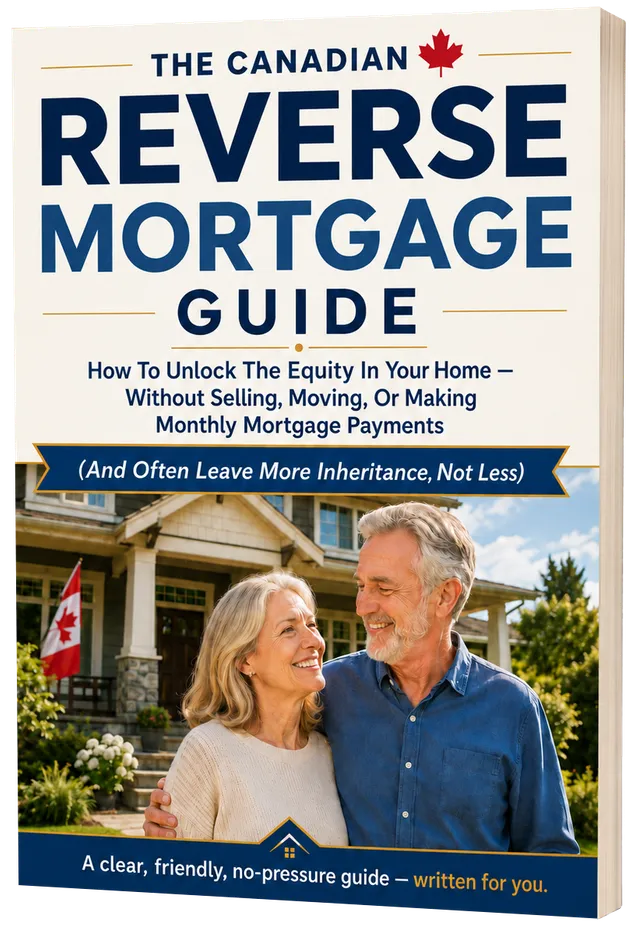
Free Guide:The Canadian Reverse Mortgage Guide
- ✓How much tax-free cash you could unlock — and what moves the number
- ✓The real costs, rates, and fees — nothing buried in fine print
- ✓How the lenders (CHIP, Equitable Bank, Home Trust, Bloom) really compare
- ✓When a reverse mortgage is the wrong choice
Simply enter your info below and a PDF copy will instantly be sent right to your inbox.
Frequently asked questions
Why does CIBC define a reverse mortgage if it doesn't offer one?
Because it's a real Canadian mortgage product, and a bank explaining mortgage terms to its customers has a reason to explain this one. CIBC's online mortgage glossary carries an entry for reverse mortgage the same way it carries entries for conventional, convertible, and open mortgages. Defining a term and offering the product are two different things, and a glossary entry isn't a sign that CIBC arranges one.
Can I get a reverse mortgage if I bank with CIBC?
Yes. Which bank holds the chequing account, the savings, or the credit card makes no difference. A reverse mortgage is registered against the home by whichever of the four lenders funds it, and CIBC accounts stay open and unchanged. One thing does change: any CIBC mortgage or line of credit secured on that home is paid off and closed from the money at closing, and the reverse mortgage replaces it.
Is the CIBC Home Power Plan a reverse mortgage?
No. The Home Power Plan combines a regular mortgage with a home equity line of credit, and it comes with required monthly payments. A reverse mortgage has no required monthly mortgage payments — interest is added to the balance instead. The other difference is approval: the Home Power Plan is approved on income, while a reverse mortgage is approved mainly on age, the home's value, and its location.
What happens if I ask about a reverse mortgage at a CIBC branch?
One of two things. Some branches say no, because CIBC has no reverse mortgage to offer. Others pass the name along to a single reverse mortgage lender, whose own salespeople then present that lender's offer. Either way the homeowner ends up with one quote rather than a comparison of all four Canadian lenders.
Get the answer your branch can't give you
A free, no-obligation estimate compares every reverse mortgage lender in Canada for your exact age and home — with no impact on your credit.
Get my free estimate About the author
Richard Hopkins
Licensed Mortgage Broker · M16000896
Richard has worked in the mortgage business since 2013 — first as a mortgage agent, today a licensed mortgage broker — and leads the reverse mortgage practice at Homestead Financial — Dominion Lending Centres, an FSRA-licensed Ontario brokerage (#11711) with roots in the industry since 1999 and more than 2,500 mortgages funded. More about Richard →
This article is general information for Canadian homeowners, not personal financial, legal, or tax advice. Everyone's situation is different — please get advice on your own numbers before making a decision.