
Reverse mortgage blog
Reverse Mortgage vs Home Equity Loan in Canada (2026)

General information for Canadian homeowners, not personal financial, legal, or tax advice. Rates and lender details verified as of July 20, 2026.

Key takeaways
- In Canada, "home equity loan" almost always means a second mortgage — one lump sum, repaid with monthly payments — or simply a new first mortgage if the home is paid off (Financial Consumer Agency of Canada).
- Banks and other lowest-rate lenders don't offer standalone second mortgages — a second mortgage usually comes from a private or subprime lender, approved mainly on the home's equity, with interest-only payments, high set-up fees, and a term of a year or two (the alternatives compared).
- A reverse mortgage is also approved on the home rather than a bank income test — age 55+, the home's value, and its location — and it has no required monthly mortgage payments, which makes it the version built to hold for years (FCAC).
- Posted 5-year fixed reverse mortgage rates run 6.23% to 6.39% as of July 2026 (Canadian Mortgage Trends) — a private second mortgage runs around 10% as a rule of thumb, plus a lender fee of 1% to 2%, while a bank lump sum on a paid-off home is simply a regular mortgage at regular mortgage rates — but it takes full income approval to get.
- The real-life choice is usually this: a second mortgage clears the high-interest debts while your first mortgage stays — a reverse mortgage pays off the first mortgage and the debts together and removes every required monthly mortgage payment. When the reverse mortgage numbers fit, consolidating everything is usually the better route (the debt-clearing routes compared).
- A private second mortgage has no guaranteed renewal, and renewing typically costs the set-up fee again — so it works as a bridge with a firm exit plan (clear the pressing bills, then sell or refinance), never as borrowing to keep (the alternatives compared).
Reverse mortgage vs home equity loan: a home equity loan is one lump sum repaid with monthly payments — usually a private second mortgage on a one-or-two-year term — while a reverse mortgage has no required monthly mortgage payments and is built for the long run.
Many Canadian homeowners past 55 want to borrow against the home they own, and want to compare the two products most often suggested for it.
The challenge is that “home equity loan” is not a precise product name in Canada. It can mean a second mortgage from a private lender, a regular mortgage a bank lends on a paid-off home, or almost any borrowing against a home — and those work very differently.
The comparison itself is simpler than the naming. A home equity loan pays one lump sum, repaid with monthly payments — and as a second mortgage it usually runs for just a year or two. A reverse mortgage also pays a lump sum, but has no required monthly mortgage payments and is built to be held for years.
This page sorts out what a home equity loan actually is, who offers one, what each costs, and which route fits which situation.
What does “home equity loan” actually mean in Canada?
It’s a description Canadians use loosely, not a product name — so the first job is sorting out what it actually means.
A second mortgage — one lump sum, repaid monthly
In almost every real case, a home equity loan is a new lump-sum mortgage on your home. If you already have a mortgage, the new loan is registered behind it as a second mortgage. If your home is paid off — free and clear — it simply becomes your only mortgage.
The money arrives once, as a single amount. Repayment starts the next month: a payment every month, on a set schedule.
That is the product this page compares. It’s not the same thing as a HELOC — a home equity line of credit, which is reusable credit you borrow from and pay back as you go, with its own head-to-head against the reverse mortgage. And the wider family of ways to take money out of a home — loan, credit line, refinance, reverse mortgage — is mapped in plain English in what equity release means in Canada.
Who offers them: mostly private lenders — not the banks
Banks and the other lowest-rate lenders (the industry calls them prime or “A” lenders) don’t offer standalone second mortgages at all. Their ways of lending against a home are the credit line and the refinance, both approved on income and credit — and on a paid-off home, a bank can lend one lump sum as a new first mortgage. That version is simply a regular mortgage, approved and priced like any other.
Second mortgages come from private lenders, plus a few subprime lenders — lenders that approve borrowers the big banks turn down. Approval is based mainly on the equity in the home, not on income and credit.
That approval is easier to get, and it’s priced for it: high set-up fees, a higher rate, and a term of just a year or two. Payments are typically interest only, so the balance doesn’t shrink on its own. It’s built for a short gap, not the long run.
A reverse mortgage is a different product from both. It’s a loan for homeowners 55 and older, secured against the home, with no required monthly mortgage payments. The interest is added to the balance instead, and the loan is repaid when you sell, move out permanently, or after the last borrower passes away. You stay on title as the owner the whole time.
How do you qualify for a home equity loan vs a reverse mortgage?
Here is the part that surprises most readers: a second mortgage and a reverse mortgage are both approved mainly on the home — not on income. What separates them is what each one is built to do afterward.
A second mortgage is approved on the home’s equity — and built to end fast
A private lender is lending against your equity — the part of the home’s value you actually own — so it doesn’t look hard at income or credit. That’s what makes the money fast, and it’s also what you pay for: high set-up fees, a higher rate, and a term of a year or two with no promise of renewal.
The bank route is the opposite. A bank’s lump-sum lending is approved the way any mortgage is — income and credit, with the bank proving on paper you could carry the payments at a higher rate than you’d actually pay. Those tests were built for a salary — and many retirement incomes don’t pass them. A paid-off home helps, but income is what the bank lends against.
A reverse mortgage is approved on age and the home — and built to stay
A reverse mortgage is also approved on the home — plus one more thing: your age.
Approval is based mainly on your age, your home’s value, and its location — for a couple, both spouses must be 55 or older, and the requirements guide covers the fine print. There’s no bank-style income test and no debt math.
The lender still looks at income, far enough to be satisfied the property taxes are comfortably affordable — a lighter look most retired homeowners meet without difficulty. Credit is reviewed too, but it’s a much smaller factor than at a bank.
How much it unlocks is set by the same things: up to 55% of the home’s value, and up to 60% at the market’s top tier for borrowers 70 and older. In Ontario, where all four reverse mortgage lenders compete for the same homeowners, the complete Ontario guide maps the whole market.
Find out what you qualify for — no income documents needed
A free estimate shows how much you could unlock based on your age and home — compared across every reverse mortgage lender in Canada. No cost, no obligation, no credit check.
Get my free estimateWhat does a home equity loan cost compared with a reverse mortgage?
Two kinds of cost matter: the rate, and what it takes to set up.
On the interest rate, the three always line up the same way: the bank’s lump sum is the cheapest, the reverse mortgage sits in the middle, and the private second costs the most.
The bank’s version — one lump sum on a paid-off home — is simply a regular mortgage, priced like one: the best regular 5-year fixed rates sat around 3.99% in July 2026. The catch: you need full income approval to get it.
Posted 5-year fixed reverse mortgage rates ran 6.23% to 6.39% as of July 20, 2026 — a premium of roughly 2 to 2.5 points over the best regular mortgages. The premium pays for patience: the lender may wait a decade or more to be repaid and can’t ask you for a payment in the meantime. Reverse mortgage rates in Canada carries the current per-lender numbers, what these rates have done since 2019, and why the sticker is only part of the real cost.
A private second mortgage costs more than both. The rule of thumb in practice is a rate around 10%, plus a lender fee of 1% to 2% of the amount borrowed — on $150,000, that fee alone is $1,500 to $3,000, and renewing typically means paying it again.
Part of that price is the order of repayment: if the home is ever sold to cover the debts, the second lender is paid back only after the first lender, and it charges more for taking that chance. The rest of the price comes from the short term.
Set-up costs: a few thousand dollars either way
A bank’s lump sum has real one-time costs: an appraisal, and a lawyer to register the mortgage — typically around $1,500 of legal work. A private second’s set-up cost is that 1% to 2% lender fee — and you pay it again at each renewal.
A reverse mortgage’s one-time costs total about $2,000 to $3,500: an appraisal (usually about $350), independent legal advice ($800 to $1,200, billed by your own lawyer), and a lender set-up fee ($795 to $1,795) built into the mortgage. Most of it is built in rather than paid from your pocket, and the fees guide itemizes every line.
The monthly bill is the biggest difference. The loan collects its payment from your bank account every month. The reverse mortgage collects nothing monthly — property taxes, home insurance, and reasonable upkeep stay your responsibility, the same as with any mortgage, but no mortgage payment is required. The next section shows what that difference means in real life.
Which route actually clears the debts: a second mortgage or a reverse mortgage?
Most homeowners comparing these two products are in the same situation: a first mortgage, plus credit cards or other high-interest debts that have become hard to keep up with. The two products deal with that situation completely differently — and that difference, more than the rates, is the real comparison.
A second mortgage leaves the first mortgage exactly where it is. It pays off the high-interest debts, and adds its own payment at around 10% — on top of the first mortgage payment, which continues.
A reverse mortgage clears everything at once. Paying off every mortgage already on the home is a built-in rule of the product — so the first mortgage and the high-interest debts go together, and the mortgage payment and the card payments end with them.
| Second mortgage route | Reverse mortgage route | |
|---|---|---|
| What it pays off | The high-interest debts only — the first mortgage stays as it is | The first mortgage and the high-interest debts, together |
| What you pay monthly afterward | The first mortgage payment continues, plus the second’s payment — typically interest only, at around 10% | No required monthly mortgage payments — property taxes, home insurance, and upkeep stay yours |
| How long it runs | A term of a year or two — then renew, with the lender fee again, or exit | For life — repaid when you sell, move out permanently, or pass away |
| What it’s built for | A bridge to a planned exit | The long run |
When the reverse mortgage numbers fit — your age and your home’s value support paying off everything owed — consolidating it all in one step is usually the better route. Every payment gone, no term ending a year later, no renewal fee waiting.
When the second mortgage is the right first move
One situation changes the answer. If your first mortgage still has years left on its term, paying it off early can cost thousands of dollars in penalty — the big banks’ charges for breaking a mortgage early regularly run that high.
In that situation, the plan can work in two steps. Step one: use a second mortgage now to pay off the high-interest debts, and leave the first mortgage alone. Step two: when the first mortgage’s term ends, replace both mortgages with one reverse mortgage.
Because the switch happens on the renewal date, there is no early-payout penalty to pay. A broker sets up the timing so the two steps line up.
The second mortgage does the short job it’s built for. The reverse mortgage does the long one.
Whichever way the numbers point for you, the advertised reverse mortgage rate isn’t always the final price. Lenders run specials they don’t publish, and a broker can often get the rate — and the set-up fee — lower than the advertised figures. That work is free: the lender pays the broker, not you.
See whether the reverse mortgage numbers fit your situation
A free, no-obligation estimate shows how much you could unlock — enough to consolidate everything, or not — compared across every reverse mortgage lender in Canada. No cost, no obligation, no credit check.
Get my free estimateIt’s worth seeing how a reverse mortgage balance grows — and how much of the home’s value stays yours — on your own numbers. The calculator below takes your home’s value, your age, and the amount you have in mind, and shows both over the years:
Here's What Happens to Your Equity
Adjust the sliders below to see how your equity can change over time.
Need more than this estimate?In some situations we can structure additional financing to unlock more of your equity — contact us to see if it fits your situation.
(80)
Your 15-Year Forecast
In 15 years, your home is projected to be worth $1,935,282 (at 4.5% growth). Even with the growing loan balance, you would still have$1,288,355in remaining equity!
*Disclaimer: These projections are for illustration purposes only and should not be considered financial advice. Projections assume 4.5% annual appreciation and 6.44% interest rate. Actual results may vary based on market conditions and individual circumstances.
Your 15-Year Forecast
In 15 years, your home is projected to be worth $1,935,282 (at 4.5% growth). Even with the growing loan balance, you would still have$1,288,355in remaining equity!
This reverse mortgage calculator is for illustration only. Your real numbers depend on your age, lender, rate, and home value — which is exactly what a free estimate works out for you.
When does a home equity loan win — and when does the reverse mortgage?
The loan side of this page is really two different products — the bank’s regular mortgage and the private second mortgage — so the answer comes in three parts.
When the bank’s regular mortgage is the better fit
- The home is paid off, and the income is there. If your house is free and clear and your cash flow makes a mortgage payment comfortable, a regular mortgage from a bank or “A” lender is usually the better borrowing: it’s the cheapest on this page, and the balance falls every month. An independent broker arranges these too.
- You’re under 55. Reverse mortgages start at 55. Below that age, the bank and private options are the whole conversation.
When the private second mortgage is the better fit
- The need is short, and the way out is already planned. Fast money against the home, paid off by a planned exit. A common version — pay off the high-interest debts and catch up on property taxes quickly, then sell the home with enough time to do it properly instead of under pressure. Kept longer than the plan, the fees and the rate make it an expensive way to borrow.
- Your first mortgage is locked in for years. Breaking it early would cost thousands in penalty, so the second clears the urgent debts now — the two-step plan covered earlier, ending in one reverse mortgage at the first mortgage’s renewal date.
When the reverse mortgage is the better fit
- The bank’s income math says no. The most common case in practice. The pension that comfortably runs a household often doesn’t clear a bank’s approval — and this is the product built to lend on age and the home instead.
- The monthly budget is the whole point. A second mortgage adds a payment to the budget; a reverse mortgage removes them — any mortgage already on the home is paid off and closed at closing, along with the high-interest debts.
- Staying for years is the plan. The product is built for staying: nothing has to be repaid until you sell, move out permanently, or the last borrower passes away. And with both spouses on the mortgage, the death of one changes nothing for the survivor — same home, same terms, no requalifying.
Sometimes the answer is both — for a while
When a reverse mortgage alone doesn’t cover everything, one lender permits a small private second mortgage behind it — up to about 65% of the home’s value, both loans combined.
Private seconds typically run interest only — so this one is set up differently, with principal-and-interest payments, and it genuinely pays down. Once it’s cleared, only the reverse mortgage remains for the long run. Setting it up takes real planning, and a broker works out case by case whether it makes sense.
How do you get out of a home equity loan or a reverse mortgage?
The two products end very differently, and the difference belongs in the decision from day one.
A bank’s home equity loan ends by being paid down, renewing like any mortgage along the way. A private second is different. With interest-only payments the balance never shrinks — the full amount is still owed when the term ends. And at the end of that one-or-two-year term, the lender decides whether to renew: renewal is not guaranteed, and renewing means paying the lender fee again. That’s why a private second without a firm exit plan turns into an expensive problem a year later.
A reverse mortgage is built to be the last mortgage — it runs until you sell, move out permanently, or pass away. Paying it all off early instead carries a charge in the first years: highest in year one, stepping down to about three months’ interest, then disappearing entirely. It’s never charged when the mortgage ends because the last borrower passed away. The year-by-year picture, and how the charges differ from lender to lender, is walked through in paying off a reverse mortgage early.
How do you choose between a home equity loan and a reverse mortgage?
Start one question earlier: whether borrowing against the home is the right move at all. Sometimes it isn’t — the need is too small to justify set-up costs, or a sale is already close and nothing is needed in the meantime.
From there, two questions decide most real situations. How long will the money be needed — a year or two, or many years? And would a monthly payment help the plan or defeat it?
A short need with a firm way out — the private second does the job. Money needed for years, with income a bank will approve — the bank routes win, and an independent broker arranges those too: a HELOC through a Canadian bank, a refinance, or a traditional mortgage. Money needed for years, with income tight and a payment unwelcome — that’s the situation the reverse mortgage was built for.
An independent mortgage broker prices every one of these routes on the same home — the reverse mortgage, the bank options, and the private second when a short bridge genuinely fits. The comparison costs you nothing, because the lender pays the broker — and that includes the advice that a different product, or no borrowing at all, is the better answer.
Whichever route fits, the same free estimate starts the conversation. What to ask before choosing who runs that comparison is covered in choosing a reverse mortgage broker.
The free guide below goes one layer deeper on the reverse side: the real costs, how the four lenders differ, and when it’s the wrong choice.
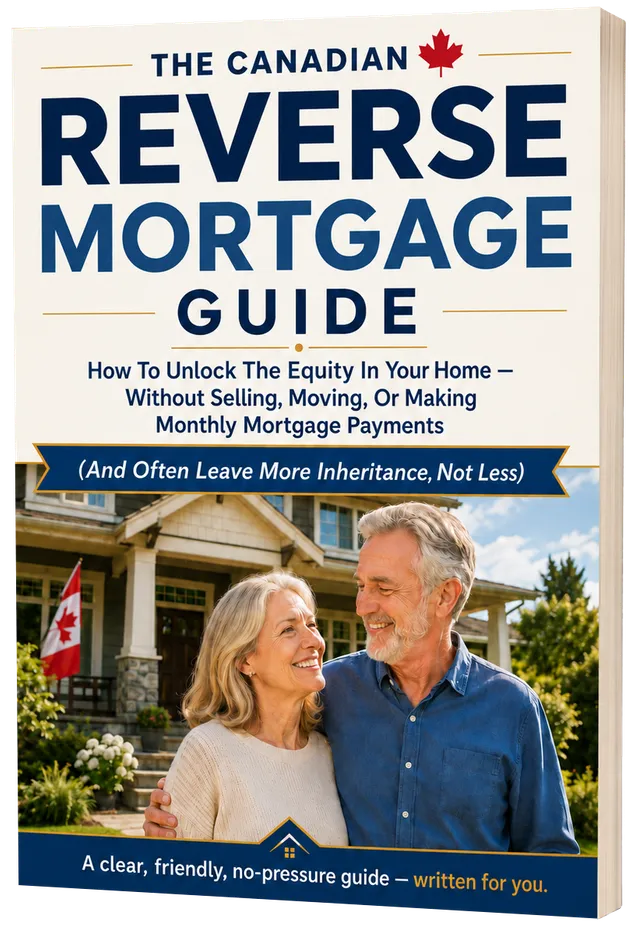
Free Guide:The Canadian Reverse Mortgage Guide
- ✓How much tax-free cash you could unlock — and what moves the number
- ✓The real costs, rates, and fees — nothing buried in fine print
- ✓How the lenders (CHIP, Equitable Bank, Home Trust, Bloom) really compare
- ✓When a reverse mortgage is the wrong choice
Simply enter your info below and a PDF copy will instantly be sent right to your inbox.
Frequently asked questions
What is the difference between a reverse mortgage and a home equity loan?
A home equity loan gives you one lump sum and you repay it with monthly payments, starting right away — and when it comes from a private lender, as most second mortgages do, the term usually runs just a year or two. A reverse mortgage also pays a lump sum, but there are no required monthly mortgage payments: the interest is added to the balance, and the loan is repaid when you sell, move out permanently, or after the last borrower passes away. Approval is based mainly on your age, your home's value, and its location — it is built for homeowners 55 and older.
Is a home equity loan the same as a second mortgage in Canada?
Usually, yes. If you already have a mortgage, a home equity loan is registered behind it as a second mortgage. If your home is paid off — free and clear — the same loan simply becomes your only mortgage. Either way it works the same: one lump sum, repaid with monthly payments.
Which is cheaper — a second mortgage or a reverse mortgage?
For borrowing held over years, usually the reverse mortgage. A private second mortgage — which is what most second mortgages are — runs around 10% as a rule of thumb, well above a reverse mortgage, plus a lender fee of 1% to 2% of the amount borrowed, and it typically charges that fee again at each one-or-two-year renewal. Used for a short time, as the bridge it is built to be, it does its job at a fair price. The genuinely cheapest lump sum is a bank mortgage on a paid-off home — a home equity loan there is simply a regular mortgage, at regular mortgage rates — but that needs full income and credit approval, which is exactly what many retired households can no longer pass.
Can you get a home equity loan with no income?
Yes — from a private or subprime lender, which is where most second mortgages come from. Approval is based mainly on the equity in the home, so limited income is workable. The trade is the price: a rate around 10% as a rule of thumb, a lender fee of 1% to 2% of the amount borrowed, and a term of a year or two with no guaranteed renewal. A bank is the opposite — its lump-sum lending needs provable income and credit. For borrowing built to last years without a bank-style income test, the reverse mortgage is the product designed for it: approval is based on age 55 and up and the home, with only a lighter check that the property taxes are comfortably affordable.
Can you have a reverse mortgage and a second mortgage at the same time?
Normally, no. A reverse mortgage pays off and closes every mortgage already on the home at closing — that is what removes the old monthly payments. There is one exception: a single lender permits a small private second mortgage behind the reverse mortgage, taking total borrowing to roughly 65% of the home's value. It is a short-term structure, not something to keep for years: ideally the second is set up with principal-and-interest payments — instead of the interest-only payments private seconds usually carry — so it genuinely pays down, and once it is cleared, only the reverse mortgage remains for the long run. A broker works out case by case whether it makes sense.
Can a mortgage broker arrange a home equity loan or a HELOC?
Yes. An independent mortgage broker arranges the bank products — HELOCs and refinances through Canadian banks, and traditional mortgages — as well as private second mortgages and reverse mortgages. One conversation can price several routes on the same home and show which comes out ahead. The work costs the homeowner nothing, because the lender pays the broker. A free estimate is the simplest way to start, whichever product turns out to be the right one.
Which one leaves more for the estate?
A home equity loan from a bank pays down — the balance falls with every payment — so if the monthly payments were carried comfortably for years, it usually leaves more equity. A reverse mortgage balance grows instead — but home values usually rise over the same years, and that growth offsets some or all of the interest. Canadian reverse mortgage borrowers keep about half their home equity on average, even after many years, and the estate never repays more than the home's fair market value at the time the mortgage becomes due, as long as the homeowner obligations were met. Which path truly leaves more depends on the years held, the rates, and the housing market — worth running with real numbers, not assumptions.
See every route priced on your actual home
Get a free, no-obligation estimate — how much you could unlock, and an independent read on whether a reverse mortgage, a bank HELOC or refinance, or a short second mortgage fits you best. No cost, no obligation, no credit check.
Get my free estimate About the author
Richard Hopkins
Licensed Mortgage Broker · M16000896
Richard has worked in the mortgage business since 2013 — first as a mortgage agent, today a licensed mortgage broker — and leads the reverse mortgage practice at Homestead Financial — Dominion Lending Centres, an FSRA-licensed Ontario brokerage (#11711) with roots in the industry since 1999 and more than 2,500 mortgages funded. More about Richard →
This article is general information for Canadian homeowners, not personal financial, legal, or tax advice. Everyone's situation is different — please get advice on your own numbers before making a decision. Rates and lender details verified as of July 20, 2026.